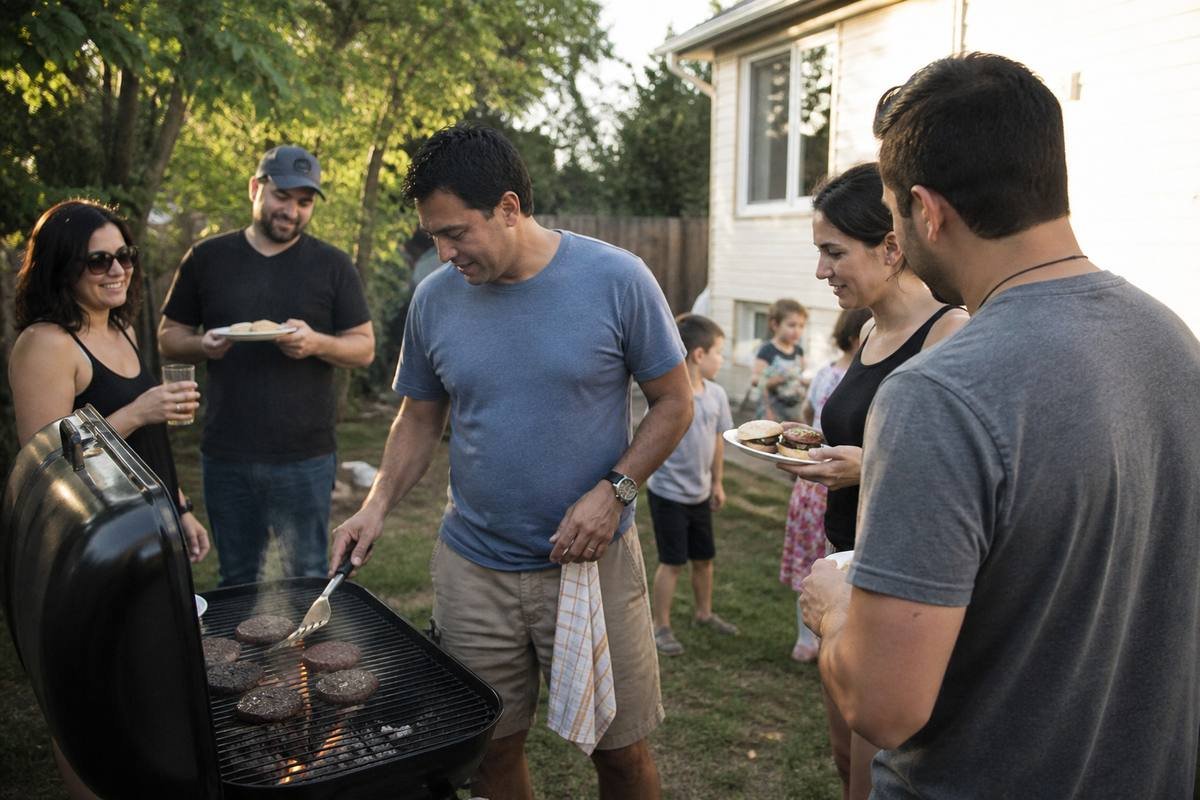
There are two kinds of burger cookouts. At the first kind, the host spends the entire afternoon trapped at the grill, squinting through smoke, serving burgers in scattered shifts so that half the guests are eating while the other half wait, and finally sitting down to their own cold patty just as everyone else finishes. At the second kind, the food arrives hot and all at once, the toppings table looks like a small festival, the host actually attends their own party, and guests talk about the burgers for weeks. The difference between these two events is not money, equipment, or talent. It is planning, and the specific, learnable logistics of cooking for a crowd. This guide covers all of it: how much food to buy, what to prepare the day before, how to set up a toppings bar that runs itself, how to manage a grill for twenty people without losing your mind, and the timeline that makes the whole afternoon look effortless.
Start with the Math: How Much Food a Crowd Actually Eats
Every cookout stands or falls on quantities, and most hosts guess. The guesses fail in both directions: run out of patties at the two-hour mark and the party deflates; over-buy by double and you spend a week eating the evidence. The numbers below are calibrated for a mixed adult crowd at a weekend afternoon cookout, where burgers are the centerpiece and appetites are healthy.
Plan on one and a half burgers per adult and one per child. This is the golden ratio of cookout planning: some guests eat one, some eat two, and it averages out with remarkable reliability. For patties in the six-ounce range, that means about nine ounces of raw ground beef per adult, and buying a modest overage is wise since patties can be frozen raw. Buns should match patties plus ten percent, because a few will be dropped, torn, or sacrificed to hot dogs.
The chart below scales the full shopping list for the three most common party sizes.
| Item | 10 Guests | 20 Guests | 30 Guests |
|---|---|---|---|
| Ground beef (80/20) | 8 pounds | 16 pounds | 24 pounds |
| Buns | 16 | 32 | 48 |
| American cheese slices | 20 | 40 | 60 |
| Lettuce | 1 large head | 2 heads | 3 heads |
| Tomatoes | 4 large | 8 large | 12 large |
| Onions | 3 | 5 | 8 |
| Pickles | 1 large jar | 2 jars | 3 jars |
| Condiments | 1 bottle each | 2 bottles each | 3 bottles each |
| Sides (total) | 5 pounds | 10 pounds | 15 pounds |
| Drinks | 30 servings | 60 servings | 90 servings |
Two notes on the table. Cheese runs at two slices per expected burger because cheese loss to snacking, doubling, and floor accidents is a law of nature. And drinks run at roughly three servings per guest for an afternoon event in warm weather, more if the day is hot, because a cookout is fundamentally an outdoor thirst-generation machine.
The Day-Before Rule: Everything That Can Be Done Early, Must Be
The single biggest upgrade to cookout hosting is a simple principle: on the day of the party, the only job should be cooking and hosting. Everything else happens the day before.
Patties are formed the day before, and this is better cooking, not just better logistics. Portion the beef with a kitchen scale, shape the patties gently, press the anti-doming dimple into each center, and stack them between squares of parchment paper on a sheet pan, covered tightly in the refrigerator. Cold, rested patties hold together better on the grill than freshly formed ones, and forming twenty patties with clean hands in a calm kitchen beats doing it with guests watching.
The vegetable prep happens the same evening. Slice tomatoes and onions, wash and dry lettuce, and stage everything in covered containers. Make the special sauce, which genuinely improves overnight as the flavors marry. Make the sides that love a rest, coleslaw, potato salad, baked beans, macaroni salad, all of which are honestly better on day two. Freeze extra ice. Set out the serving platters, tongs, and napkins on the counter. Even the toppings bar can be assembled cold and covered, needing only a transfer outdoors.
What waits for party day: seasoning the patties (salt applied early changes the texture of the meat), toasting buns, and the actual grilling. That is the entire day-of cooking list, and it is short by design.
The Toppings Bar: Let the Party Serve Itself
A cookout for a crowd cannot custom-build sandwiches to order, and it should not try. The professional move, borrowed from every successful burger restaurant with a fixings counter, is the self-serve toppings bar, which turns the host’s hardest job into the guests’ favorite activity.
The physical setup matters. Use a long table, arranged in assembly order so traffic flows one direction: plates and buns first, then sauces, then lettuce, tomato, onion, and pickles, then the premium extras, with napkins and sides at the far end. Guests pick up a bun, receive a hot patty from the grill master midway down the line, and dress it themselves as they move. One-directional flow prevents the clot of people all reaching across each other for the mustard.
Stock the bar in three tiers. The essentials: ketchup, yellow mustard, mayonnaise, the homemade special sauce (label it; a hand-written card reading “House Sauce” earns disproportionate delight), lettuce, tomato, red onion, and dill pickles. The upgrades: caramelized onions kept warm in a small slow cooker, crisp bacon by the half-strip, sliced jalapeños, barbecue sauce, and sliced avocado tossed with lime juice to slow browning. The wildcards, choose two: coleslaw for topping, fried onions, pickled red onions, pepper jack alongside the American, a jar of good hot sauce. Keep cold items nested in bowls set into a larger tray of ice, both for safety and because a cold, crisp tomato slice on a warm afternoon is a better tomato slice.
Managing the Grill: Feeding Twenty Without Chaos
The grill is where cookouts collapse, because a standard grill cooks eight to ten patties at a time and a hungry crowd wants thirty. The solution is not heroic speed. It is batching, staging, and the two-zone fire.
Set the grill up with a hot zone and a low zone, whether that means banking charcoal to one side or running one burner low. Sear the patties over the hot side, then slide finished burgers to the low zone, where they hold at serving temperature without further cooking for a surprisingly long window. This turns the grill into both stove and warming oven, and it means burgers can be produced in continuous batches and released all at once, the whole crowd eating together instead of in sad shifts.
Cheese goes on during the last minute in the low zone, with the lid down to trap the melting steam. Buns toast in thirty-second flights over the hot zone as the last patties finish, and toasted buns are non-negotiable at a cookout, where a burger may sit on a paper plate for ten minutes; the toast is the structural barrier that keeps it from dissolving.
A few crowd-scale safety rules carry real weight. Use a thermometer, and for a mixed crowd of unknown preferences and vulnerabilities, cook to 160 degrees; a backyard is not the venue for medium-rare gambling with other people’s health. Keep raw and cooked platters strictly separate, with separate tongs, and never walk the cooked burgers out on the plate that carried the raw patties. In summer heat, cold food sits on ice and mayonnaise-based sides go back into the cooler after serving, because the classic cookout villain is not the burger but the potato salad that spent three hours in the sun.
Feeding Everyone: Kids, Vegetarians, and the Bunless
A great cookout plans for the whole guest list, not just the beef-eaters. Children are simple: smaller patties, plain cheese, ketchup, and a stack of napkins; forming a half-dozen three-ounce kid patties costs nothing during day-before prep. Vegetarian guests deserve better than a shrug, and the modern plant-based patties grill well enough that the accommodation is easy, with one iron rule: cook them on a separate corner of the grill, or on a foil sheet, with their own spatula, and announce it. The consideration is remembered long after the party. For low-carb guests, a stack of washed butter lettuce leaves at the head of the toppings bar quietly serves the bunless without a word of fuss. And a package of hot dogs on the cool corner of the grill is cheap insurance against the one guest at every cookout who, confronted with the finest burger of the summer, wants a hot dog.
The Day-Of Timeline
Here is the full sequence, assuming guests arrive at 2:00 in the afternoon.
The morning is for the house and yard: tables out, trash cans stationed visibly (guests will hold garbage for an hour rather than ask), drinks and ice loaded into coolers, shade arranged. At noon, pull the patties from the refrigerator to the back of the fridge’s coldest shelf, ready for their moment. At 1:00, set the toppings bar with the cold items still covered, and light the charcoal or check the gas level, the saddest cookout sentence in America being “I think we’re out of propane.” At 1:45, uncover the bar and stage the raw patties, still cold, beside the grill.
At 2:15, when the early guests have settled, begin the first batch, seasoning the patties as they hit the grate. Run continuous batches through the two-zone system, hold the finished burgers warm, and call the whole party to eat at once around 2:45. The second wave of patties, for the two-burger contingent, goes on as the first wave sits down. By 3:15, the grill master closes the lid, makes a plate, and joins the party they are hosting, which is, in the end, the entire point.
The Real Secret
Strip away the details and the ultimate burger cookout rests on three ideas. Buy by the numbers instead of by instinct. Move every possible task to the day before, so that party day contains only fire and friends. And build systems, the toppings bar, the two-zone grill, the one-way table, that let the event run without a manager. Do these things and the food will be better, but that is almost beside the point. The real product of all this planning is the sight of the host, plate in hand, sitting down in the shade in the middle of their own party, and that, even more than the perfect patty, is what guests remember when they talk about the best cookout of the summer.
Leave a Reply