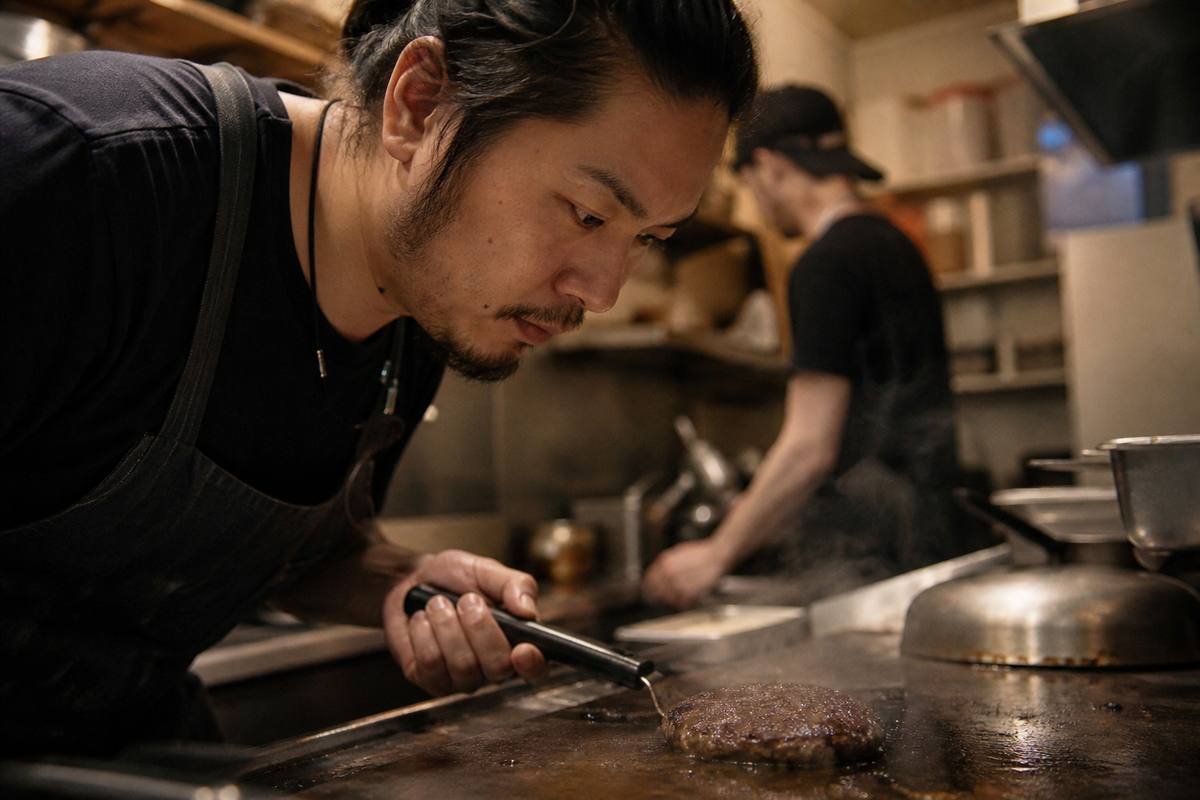
Every cook who has ever flipped a patty has a set of beliefs about burgers. Sear the meat to lock in the juices. Flip it only once. Never salt too early. Press it flat for faster cooking. Some of these beliefs are sound science, some are harmless folklore, and at least one is completely backward. The difference matters, because a burger is not a mystery; it is a chemistry experiment conducted at four hundred degrees, and every variable, from the fat percentage of the grind to the timing of the salt to the number of flips, has a measurable effect on the outcome. This article walks through the actual science of burger cooking: the browning reactions that create flavor, the protein behavior that determines texture, the physics of juiciness, and the experimental evidence that settles the old backyard debates once and for all. None of it requires a laboratory. All of it will make your next burger better.
The Maillard Reaction: Where Flavor Is Born
The single most important chemical event in burger cooking is the Maillard reaction, named for the French chemist Louis-Camille Maillard, who described it in 1912. It is the cascade of reactions that occurs when amino acids and certain sugars in the meat’s surface are heated together, producing hundreds of new aromatic compounds and the deep brown color we associate with delicious food.
It is worth being precise about what the Maillard reaction is not. It is not caramelization, which involves only sugars and happens in onions and desserts. And it is not “searing in the juices,” a phrase that refuses to die despite being debunked by food scientists for decades. A seared crust is not waterproof; browned meat loses moisture at essentially the same rate as unbrowned meat. The sear does not preserve juiciness. What it does is create flavor, and it creates so much of it that the trade is worth making anyway.
The Maillard reaction has demanding requirements. It proceeds meaningfully only above roughly 280 degrees Fahrenheit and works fastest between 300 and 500 degrees. It also requires a relatively dry surface, because as long as the meat’s exterior is wet, the water absorbs the heat and holds the surface temperature near the boiling point of 212 degrees, far below browning range. This single fact explains an enormous amount of burger practice. It is why a crowded pan produces gray, steamed patties: the released moisture cannot evaporate fast enough. It is why patting patties dry before cooking improves the crust. And it is why the pan or grill must be properly preheated, because a lukewarm surface spends its first several minutes merely boiling the meat’s exterior moisture instead of browning it.
The following table summarizes what happens to a burger’s surface across the temperature range.
| Surface Temperature | What Is Happening | Result on the Patty |
|---|---|---|
| Below 212°F | Water simmers and steams | Gray, boiled surface, no flavor development |
| 212 to 280°F | Moisture evaporates slowly | Pale surface, slow drying |
| 280 to 330°F | Maillard reaction begins | Light browning, mild roasted notes |
| 330 to 450°F | Maillard reaction peaks | Deep brown crust, hundreds of flavor compounds |
| Above 500°F | Pyrolysis begins to dominate | Charring, bitterness, acrid smoke |
The practical target is a cooking surface around 400 to 450 degrees: hot enough for a rapid, deep sear, cool enough to avoid the bitter compounds of genuine burning.
Why the Smash Burger Works: Surface Area as Strategy
Once you understand that browning equals flavor and that browning happens only where meat touches hot metal, the logic of the smash burger becomes obvious. A thick, gently placed patty touches the griddle only at its lowest points; on a microscopic level, its underside is a landscape of hills and valleys, and only the hills make contact. Smashing the patty hard in the first seconds flattens those hills, forcing nearly one hundred percent of the surface into contact with the metal. More contact means more Maillard reaction per gram of beef, which is why a four-ounce smashed patty can out-flavor an eight-ounce thick one.
The timing rule, smash immediately and never again, is also pure science. In the first moments of cooking, the patty’s proteins have not yet contracted and its juices are still bound within muscle cells; pressing loses almost nothing. Thirty seconds later, heat has begun squeezing those cells like sponges, and any pressure evicts free-flowing juices onto the griddle, where they steam the crust you just built. Same action, different moment, opposite result.
Protein, Fat, and the Texture Problem
A burger’s texture is governed by two proteins and one fat, and the interplay among them explains nearly every dense, rubbery burger ever served.
Myosin is the protein that matters most. When ground beef is worked, kneaded, pressed repeatedly, or salted in advance, myosin dissolves and becomes sticky, cross-linking the meat into a cohesive, springy network. This is exactly what you want in sausage, which is why sausage recipes demand vigorous mixing with salt. It is exactly what you do not want in a burger, which should remain a loose aggregation of tender crumbles. The scientific case for handling patties minimally, and for salting only the exterior just before cooking, is not chef superstition; it is myosin management. Salt mixed into the grind even thirty minutes ahead produces a measurably bouncier, more sausage-like patty, a result confirmed in side-by-side kitchen tests by multiple food science writers.
Fat plays the opposite role. Beef fat begins rendering around 130 to 140 degrees, lubricating the protein network, carrying fat-soluble flavor compounds across the tongue, and creating the perception of juiciness even as actual water is lost. This is why an 80/20 patty cooked to medium tastes juicier than a 90/10 patty cooked medium-rare: perceived juiciness tracks fat at least as much as it tracks moisture. Fat is also chemically responsible for “beefy” flavor; many of the aromatic compounds that distinguish beef from other meats live in the fat, not the muscle. Lean burgers do not merely taste dry. They taste less like beef.
Water, the third player, makes up roughly seventy percent of raw muscle. As internal temperature climbs past about 140 degrees, protein contraction squeezes water out with increasing aggression, which is why the jump from medium to well-done costs a patty a large share of its moisture. Every degree past your minimum acceptable doneness is a straightforwardly bad trade.
The Flipping Debate, Settled by Thermodynamics
Backyard wisdom says flip a burger exactly once, on the theory that repeated flipping disturbs cooking and dries the meat. Kitchen scientists, most famously J. Kenji López-Alt in his restaurant and laboratory testing, have run the experiment repeatedly, and the folklore loses.
Flipping a thick patty every thirty seconds or so cooks it up to thirty percent faster and more evenly than flipping once. The reason is heat geometry. With a single flip, one side of the burger spends minutes facing up, radiating heat away and cooling, while the down side absorbs a long, harsh blast that overcooks a thick gray band beneath the crust. Frequent flipping keeps both faces alternately in contact with the heat, so neither side ever fully cools nor fully overheats; the effect approximates cooking the burger gently from both directions at once, like a two-sided grill. The result is a broader band of evenly cooked interior and, because total cooking time drops, less overall moisture loss.
The one-flip rule survives for two legitimate reasons: on a grill, fewer flips reduce the chance of a delicate patty breaking through the grates, and in a restaurant, nobody has time to babysit twelve burgers. At home, with a sturdy patty and a spatula, flip as often as you like. The only genuine rule is to wait until the first side releases from the surface without tearing, which signals that the crust has formed enough to hold itself together.
Carryover Cooking and the Case for Resting
A burger pulled from the heat is not finished cooking. Its exterior may be 300 degrees while its center reads 130, and heat flows from hot to cold regions until they equalize. This carryover effect raises a typical thick patty’s core temperature by roughly five degrees after it leaves the pan, which is why the correct practice is to pull the burger five degrees short of the target and let physics complete the job.
Resting serves a second purpose. At peak temperature, the patty’s water is thin, energetic, and concentrated toward the cooler center, ready to flood out at the first cut. During a three-to-four-minute rest, the meat cools slightly, the liquid thickens as dissolved proteins begin to set, and moisture redistributes outward into the drier regions near the crust. The measurable result is less juice on the plate and more in the meat. Burgers need far less rest than steaks, and thin smash patties need essentially none, but giving a thick pub burger those few minutes under loose foil is the cheapest upgrade in cooking.
Cheese, Steam, and the Physics of the Melt
Even the cheese on a burger obeys interesting rules. Cheese is a gel of protein, fat, and water, and melting it means loosening the protein network without breaking it. Aged cheeses like sharp cheddar have tightly bonded, calcium-rich protein structures that tend to rupture under heat, leaking fat and turning grainy. American cheese is engineered around this problem: emulsifying salts swap out calcium and let the proteins release each other gracefully, producing a smooth flow at barely 90 degrees Fahrenheit. Chemistry, not nostalgia, is why it out-melts everything in the dairy case.
Melting speed also depends on heat delivery, and the fastest carrier of heat in any kitchen is steam. Water vapor condensing on a cool cheese slice dumps enormous energy into it almost instantly, which is why the professional move, a slice of cheese, a teaspoon of water flicked into the pan, and a lid clapped on for thirty seconds, produces a perfect drape before the patty has time to overcook. The dome on a diner flat-top exists for exactly this reason.
From Laboratory to Backyard: The Rules That Survive
Strip away the folklore and the science of the burger reduces to a short list of defensible laws. Buy fat, because fat is flavor chemistry, not indulgence. Handle the meat as little as possible and salt only the surface, only at the end, because myosin is not your friend. Dry the patties, heat the surface into the Maillard window, and give the crust room to breathe by never crowding the pan. Smash early or press never. Flip as often as you please once the crust releases. Trust a thermometer over your eyes, subtract five degrees for carryover, and give thick patties a short rest before the bun.
None of these rules requires talent. They require only the willingness to believe evidence over inherited wisdom, which, as it happens, is also how the burger itself went from a dubious five-cent sandwich to the most studied, argued-over, and beloved item in American cooking. The chemistry was always there, working in every diner and backyard in the country. Now it is working for you.
Leave a Reply