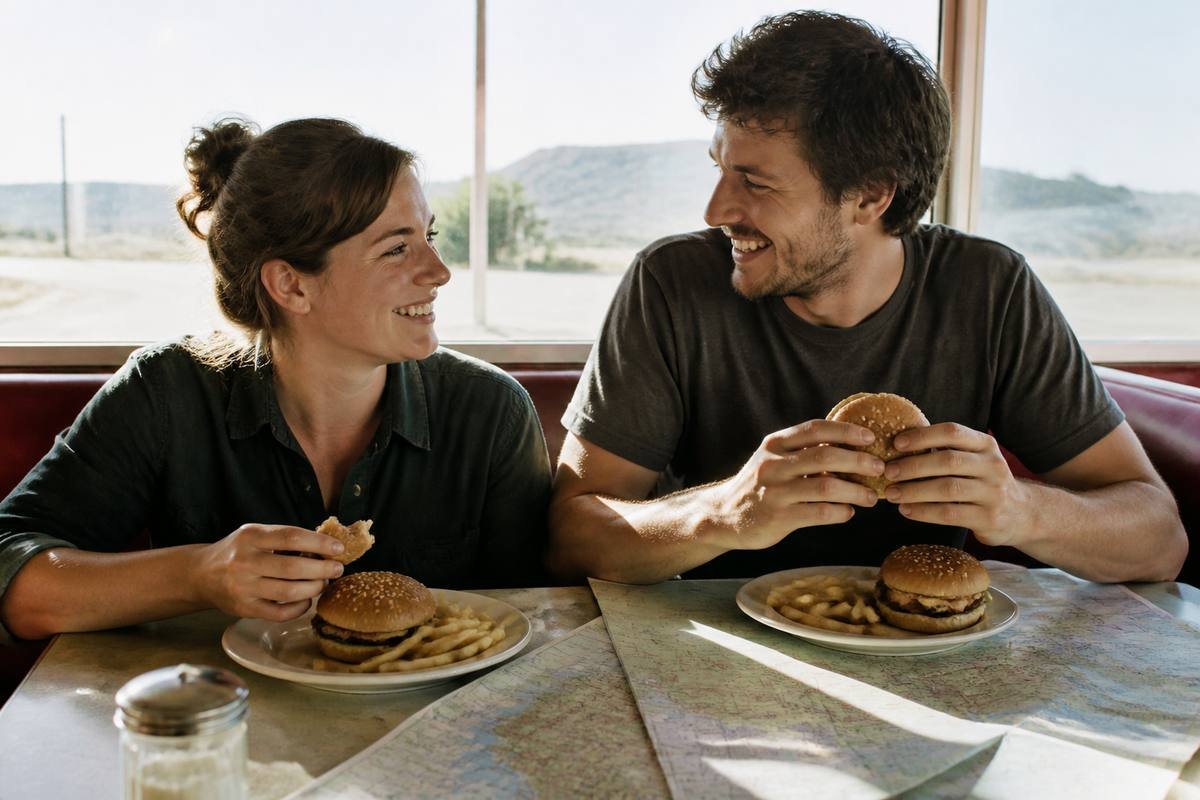
The Great American Burger Road Trip: Nine Regional Styles Worth Driving For
Every country has its famous dishes, but America has something rarer: a single dish that changes its personality every few hundred miles. Order a burger in El Reno, Oklahoma, and it arrives fused with a haystack of caramelized onions. Order one in Meriden, Connecticut, and it comes out of a steam cabinet, soft and dripping with molten cheddar. In Salt Lake City it wears a pile of pastrami; in Memphis, the entire patty has been deep-fried; in Minneapolis, the cheese hides inside the meat and burns the unwary. These are not gimmicks invented for social media. Most of them are Depression-era survival cooking or mid-century diner traditions that never left their hometowns, which is exactly why they are worth the drive. This article maps out nine of America’s greatest regional burger styles, the towns that guard them, and what to expect when you finally slide into the booth.
Why Regional Burgers Exist at All
Before the interstate highway system and national chains homogenized American food, burgers evolved in isolation, shaped by local economics and local ingredients. The pattern repeats across nearly every style on this list: a cook in the 1920s or 1930s needed to stretch expensive beef or distinguish a tiny diner from the one across the street, hit upon a technique, and the town adopted it as gospel. Children grew up on it, moved away, came home craving it, and passed the craving on. Chains never bothered to copy these styles because they were too local to matter, and that neglect preserved them. What survives today is a living museum of American ingenuity, served in wax paper.
Stop One: The Fried Onion Burger of El Reno, Oklahoma
Begin in the town that turned poverty into perfection. In 1926, at the Hamburger Inn in El Reno, a cook named Ross Davis faced the eternal Depression problem: beef was dear and customers were broke. His solution was to smash a small ball of beef onto the griddle and then smash half an onion’s worth of paper-thin slices directly into the raw meat. As the patty cooked, the onions caramelized and fused into the beef, so that a nickel burger ate like a much bigger one.
The result, it turned out, was not a compromise but an improvement. The onions steam the beef from above while the griddle sears it from below, and their sugars char into a sweet-savory lace around the edges. Three shrines in El Reno keep the flame: Sid’s Diner, Johnnie’s Hamburgers & Coneys, and Robert’s Grill, the latter operating since 1926. Order it with mustard and pickles, the traditional dressing, and skip the ketchup, which locals regard as a confession of ignorance. On the first weekend in May, El Reno hosts a festival where volunteers build a fried onion burger the size of a wading pool.
Stop Two: The Juicy Lucy of Minneapolis, Minnesota
Drive north to the Twin Cities for the most theatrical burger in America. The Juicy Lucy (or Jucy Lucy, depending on which bar you believe) is an inside-out cheeseburger: two thin patties crimped around a core of American cheese, cooked until the center liquefies into molten lava.
The origin dispute is a genuine Minneapolis institution. Matt’s Bar on Cedar Avenue, which spells it “Jucy Lucy,” says a customer in 1954 asked for cheese sealed inside his patty, took a bite, and exclaimed, “That’s one juicy Lucy!” The 5-8 Club, a former speakeasy a couple of miles away, spells it properly and claims priority. The two have feuded amiably for seventy years, and the correct tourist itinerary is to eat at both in one afternoon and declare a personal winner. Wherever you order, obey the servers’ universal warning: wait two full minutes before biting, because the cheese core holds heat like a geological event. The burger comes with fried onions and pickles, and it needs nothing else.
Stop Three: The Steamed Cheeseburger of Meriden, Connecticut
New England’s contribution is the strangest and rarest style on the map, found almost exclusively within fifteen miles of Meriden, Connecticut. Here, burgers never touch a grill. Instead, patties cook in small stainless trays inside a steam cabinet, alongside separate trays holding blocks of sharp Vermont cheddar. The steam melts the cheese into a thick, pourable sauce and cooks the beef into something impossibly tender and juicy, with no crust whatsoever.
The style descends from the “steamed beef” sandwiches sold from lunch wagons in the 1890s, making it arguably older than the grilled burger itself. Ted’s Restaurant, a tiny counter joint operating since 1959, is the undisputed cathedral: the cheese is ladled over the patty in a molten cascade, the kaiser roll drinks up the juices, and the whole thing eats more like a hot beef stew in sandwich form than a conventional burger. It is entirely unlike anything else in this article, which is precisely the point.
Stop Four: The Butter Burger of Milwaukee, Wisconsin
Wisconsin’s entry answers a question no one needed to ask, how could a cheeseburger be richer, with a solution no one regrets. The butter burger tops the finished patty, or the toasted bun, with real butter, which melts into the hot beef and soaks downward. Solly’s Grille in Milwaukee, serving since 1936, remains the maximalist standard-bearer; its version carries what appears to be a full tablespoon of lightly salted Wisconsin butter pooling on top, along with stewed onions. Culver’s carried a politer version of the tradition nationwide, but the Milwaukee original is an experience of a different order. Order a chocolate malt, embrace the excess, and plan a light dinner.
Stop Five: The Slugburger of Corinth, Mississippi
The South’s Depression-era answer to expensive beef was extension rather than onions. The slugburger, born in Corinth, Mississippi, in the 1920s, blends ground meat, originally pork, with flour or soybean meal, forms it into a thin patty, and deep-fries it until the exterior crisps like a fritter. The name has nothing to do with mollusks; a “slug” was slang for a nickel, the burger’s original price. Dressed simply with mustard, pickles, and onions, it is crunchy, savory, and utterly its own thing. Corinth still holds an annual Slugburger Festival every July, complete with a burger-eating championship, and the White Trolley Café serves the definitive version.
Stop Six: The Deep-Fried Burger of Memphis, Tennessee
A few hours west, Memphis offers the slugburger’s rowdier cousin. At Dyer’s Burgers on Beale Street, the patties are not extended, but they are deep-fried, and here is the astonishing part, they have been fried in the same continuously strained and replenished grease since 1912. The century-old fat, filtered daily and legendary locally, gives the thin patties a flavor and crackling texture that a flat-top cannot replicate. It sounds like a dare and eats like a revelation. Order the double with cheese, and accept that this is a once-a-year indulgence by design.
Stop Seven: The Pastrami Burger of Salt Lake City, Utah
Utah’s signature is younger than most, and its family tree runs through Greek immigrants and Southern California. In the 1970s, Greek-American burger men brought the pastrami-topped cheeseburger from Anaheim to Salt Lake City, where a drive-in called Crown Burgers perfected it in 1978 and made it the state’s default deluxe order. A quarter-pound patty is buried under a generous tangle of thin-sliced, griddle-crisped pastrami, then dressed with American cheese, shredded lettuce, tomato, onions, and fry sauce, Utah’s beloved blend of ketchup and mayonnaise. The smoky, peppery pastrami reads as bacon’s more sophisticated cousin, and the combination is so coherent it is a wonder the rest of the country has not stolen it yet.
Stop Eight: The Green Chile Cheeseburger of New Mexico
In New Mexico, the burger question is the state question: red or green? For burgers the answer is green, specifically Hatch Valley green chiles, roasted until blistered, peeled, chopped, and piled onto a cheeseburger where their smoky, grassy heat cuts the richness like nothing else in American cooking. The style likely began at the Owl Bar & Café in San Antonio, New Mexico, in the 1940s, reputedly feeding Manhattan Project scientists driving to and from the Trinity site. The state tourism department now publishes an official Green Chile Cheeseburger Trail with dozens of certified stops; the Owl Bar, Sparky’s in Hatch itself, and Santa Fe’s Shake Foundation anchor any serious itinerary. Late summer, when the roasters spin in every parking lot and the whole state smells of charred chile, is the correct season for this pilgrimage.
Stop Nine: The Tavern Burger of Sioux Falls, South Dakota, and the Loose Meat Legacy
The final stop honors the burger that abandoned the patty altogether. The loose meat sandwich, called a tavern in South Dakota, a Maid-Rite in Iowa, and a canteen in certain Missouri towns, is seasoned ground beef cooked crumbled, never pressed, and served heaped on a bun with mustard, pickles, and onion. Ye Olde Tavern in Sioux Falls and the Maid-Rite chain, founded in Muscatine, Iowa, in 1926, keep the tradition alive. Eating one requires a spoon for the fallen crumbles and a certain Midwestern humility, and it delivers pure, unstructured beef pleasure that patty loyalists do not know they are missing.
Planning the Route
For travelers plotting an actual journey, the styles cluster conveniently into three achievable trips.
| Route | Stops | Signature Styles | Best Season |
|---|---|---|---|
| Heartland Loop | Minneapolis, Sioux Falls, Milwaukee | Juicy Lucy, tavern burger, butter burger | Summer |
| Southern Swing | Corinth, Memphis, El Reno | Slugburger, deep-fried burger, onion burger | Spring or fall |
| Southwest Run | Salt Lake City, Hatch, San Antonio NM | Pastrami burger, green chile cheeseburger | Late summer chile season |
| Northeast Detour | Meriden, New Haven | Steamed cheeseburger, original toast burger | Any season |
The Northeast detour pairs naturally with a stop at Louis’ Lunch in New Haven, where the hamburger’s most officially recognized origin story is still served daily on toasted bread, vertical broilers and all.
The Case for Eating Locally, Deliberately
It would be easy to read this list as nostalgia, but these burgers are not museum pieces. Every one of them is a working answer to the question of what a burger can be, and most of them predate, and outclass, the standardized version the chains taught the country to expect. They survive because families kept griddles hot through wars, recessions, and highway bypasses, and they will continue to survive only as long as travelers keep pulling off the interstate.
So the next time a road trip routes you within fifty miles of El Reno or Meriden or the Hatch Valley, take the exit. Sit at the counter. Order what the town orders, exactly the way the town orders it, mustard instead of ketchup, two-minute wait before the first bite, green over red. You will eat well, you will eat cheaply, and you will taste a version of America that never made it onto the national menu, which is exactly what makes it worth the detour.
Leave a Reply