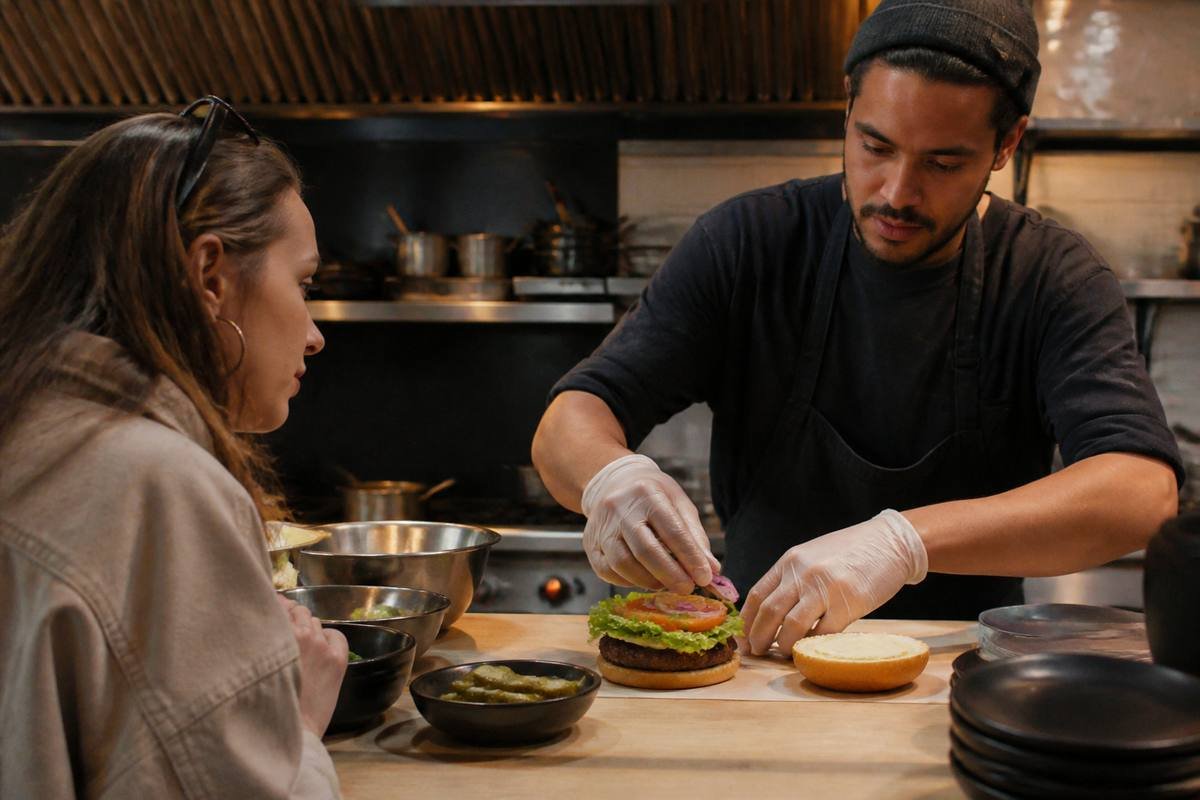
A burger patty, no matter how perfectly cooked, is only half a burger. The other half is everything you stack on top of it, and this is where most burgers are either elevated into something memorable or quietly ruined. Too many toppings and the beef disappears under a cold salad. Too few and the sandwich feels unfinished. The wrong cheese slides off in a greasy sheet; the wrong sauce turns the bun to paste; a thick slab of raw onion bullies every other flavor off the plate. Great burger builders, whether they work a diner flat-top or a backyard grill, understand that toppings are not decoration. They are a system of flavors, textures, and temperatures that must be chosen and arranged with intention. This guide covers every layer of that system: the cheeses, the vegetables, the sauces, the premium upgrades, and the architecture that holds it all together.
The First Principle: Every Topping Needs a Job
Before examining individual ingredients, it helps to understand what toppings actually do. Every element on a burger should contribute at least one of five things: richness, acidity, crunch, sweetness, or heat.
Richness comes from cheese, bacon, fried eggs, and creamy sauces, and it amplifies the indulgent character of the beef. Acidity comes from pickles, mustard, tomatoes, and vinegar-based sauces, and it cuts through the fat so the third bite tastes as good as the first. Crunch comes from lettuce, raw onion, pickles, and crispy bacon, providing contrast to the soft patty and bun. Sweetness comes from caramelized onions, ketchup, and certain buns, rounding out sharp edges. Heat comes from jalapeños, pepper jack, chipotle mayo, and hot sauce, adding excitement and keeping the palate awake.
A well-built burger touches most of these categories without doubling up too heavily on any one. The classic cheeseburger with American cheese, lettuce, tomato, pickles, onion, ketchup, and mustard endures precisely because it covers all five bases in a single stack. When a burger tastes flat or exhausting, the diagnosis is almost always a missing category, usually acidity, or an overdose of richness.
Cheese: The Most Important Decision After the Beef
Cheese is the topping that bonds physically with the patty, melting into its crevices and becoming inseparable from the meat itself. Choosing it deserves real thought.
The Case for American Cheese
Food snobs love to sneer at American cheese, but virtually every legendary burger joint in the country uses it, and the reason is science, not laziness. American cheese contains emulsifying salts that let it melt at a low temperature into a smooth, creamy layer without ever breaking into grease. Aged cheeses, by contrast, tend to separate when heated, leaking oil while their solids turn stringy or grainy. On a burger, texture is the whole game, and no cheese drapes like American.
The Full Cheese Lineup
That said, the world of burger cheese is wide, and different styles reward different builds. The table below matches the most popular options to their strengths.
| Cheese | Melting Quality | Flavor Profile | Best Pairing |
|---|---|---|---|
| American | Flawless, creamy | Mild, salty, nostalgic | Classic and smash burgers |
| Cheddar (medium) | Good with cover | Tangy, buttery | Bacon burgers |
| Sharp cheddar | Prone to greasiness | Bold, sharp | Use thin slices, strong toppings |
| Swiss | Very good | Nutty, mild | Mushroom burgers |
| Pepper jack | Very good | Creamy with chile heat | Southwestern builds |
| Blue cheese | Softens, does not drape | Pungent, salty | Thick pub burgers, caramelized onion |
| Smoked gouda | Good | Smoky, rich | Barbecue-style burgers |
| Provolone | Very good | Mild, milky | Italian-inspired builds |
Whichever cheese you choose, the technique is the same: add it during the last minute of cooking and create steam by covering the pan or closing the grill lid. A properly melted slice should hug the patty’s edges like a blanket, not sit on top like a hat.
The Produce Layer: Lettuce, Tomato, Onion, and Pickles
Vegetables on a burger walk a fine line. They provide the freshness, crunch, and acidity that balance the richness of beef and cheese, but treated carelessly they add water, chill, and blandness.
Lettuce
Iceberg is the correct burger lettuce, and this is one of the few places in cooking where the least fashionable option is the best one. Its job is crunch and coolness, not flavor, and no other variety crunches like iceberg. Use a single crisp leaf or a thin bed of shreds. Shredded lettuce, diner-style, distributes crunch through every bite and helps hold sauces. Romaine works acceptably; spring mix and arugula belong on gourmet builds where their pepperiness is chosen deliberately, and butter lettuce is the standard wrap for bunless burgers.
Tomato
A burger tomato must be ripe, and it must be thin. A thick slice of pale winter tomato is a water hazard that slides around and dilutes everything it touches. In summer, a quarter-inch slice of a genuinely ripe beefsteak tomato, lightly salted, is one of the finest things that can happen to a burger. Out of season, consider skipping tomato entirely rather than serving a pink impostor; a little extra pickle covers the acidity it would have provided.
Onion
Onion is really four different toppings depending on preparation. Raw red onion, sliced into thin rings, delivers sharp bite and crunch for those who want it. Raw white or sweet onion, diced fine in the diner tradition, gives gentler pungency distributed evenly. Grilled onions, cooked soft and golden on the flat-top, add mellow sweetness and steam-softened texture, the In-N-Out approach. Caramelized onions, cooked slowly for thirty minutes or more until deep brown and jammy, are a premium topping that transforms a burger into something closer to French onion soup in sandwich form. Match the onion to the build: raw for classic burgers, grilled for griddle-style, caramelized for blue cheese and Swiss.
Pickles
Pickles are the unsung heroes of burger construction, and their absence is the most common flaw in homemade burgers. Dill pickle chips deliver the acidity and salt that reset the palate between rich bites. Use three or four thin chips distributed across the patty, not a single thick spear’s worth in the center. Bread-and-butter pickles add sweetness along with tang and pair especially well with spicy builds. Anyone serious about burgers should try making quick pickles at home; cucumbers, hot vinegar brine, and twenty-four hours in the refrigerator produce a crunchier, brighter pickle than anything in the supermarket aisle.
Sauces: The Glue That Holds the Experience Together
Sauce is where a burger acquires its personality, and it is also where restraint matters most. The correct amount is a thin, even layer on the bun, roughly a tablespoon total. More than that and the sandwich hydroplanes.
Ketchup and yellow mustard remain the foundational duo, sweetness and tang in primary colors, and they work best together rather than alone. Mayonnaise is the quiet workhorse, adding richness and moisture, and it doubles as insulation that keeps bun and juices apart. Beyond the basics, the modern burger world runs on special sauce, and nearly every famous version is a variation on the same idea: mayonnaise, ketchup, sweet pickle relish, and a splash of vinegar, blended pink. A homemade version takes ninety seconds: half a cup of mayonnaise, two tablespoons of ketchup, one tablespoon of finely chopped pickles or relish, a teaspoon of yellow mustard, a dash of pickle brine, and a pinch of smoked paprika. It keeps for a week and improves overnight.
Barbecue sauce suits smoky builds with bacon and cheddar but should be applied sparingly because its sugar dominates. Chipotle mayonnaise, garlic aioli, ranch, and comeback sauce all have their devotees. Two general rules keep sauce choices honest: never use more than two sauces on one burger, and always place at least one of them on the bottom bun where it seasons every bite from the first.
Premium Upgrades: Bacon, Eggs, Mushrooms, and Beyond
Beyond the standard toppings lies the territory of the deluxe burger, where a few well-chosen upgrades justify a bigger napkin.
Bacon is the most beloved upgrade in America, and the secret to great burger bacon is thickness and placement. Thick-cut bacon, cooked flat in the oven until crisp but still slightly chewy, should be broken to fit the patty so that every bite contains some; two full strips laid parallel guarantee that half the bites contain none. A fried egg with a runny yolk turns a burger into a knife-and-fork event, the yolk acting as a warm, rich sauce; it pairs best with bacon and cheddar on a sturdy bun. Sautéed mushrooms, cooked in butter until their moisture is gone and their edges brown, bring deep savory flavor that makes a Swiss cheeseburger taste twice as beefy. Avocado adds cool creaminess to California-style builds, better sliced than mashed so it stays put. Crispy fried onions contribute crunch and sweetness at once, an onion ring inside the sandwich. Jalapeños, fresh or pickled, and roasted green chiles in the New Mexico style bring the heat that rich builds crave. And for special occasions, a pile of pulled pork, a slick of truffle aioli, or a slab of grilled pineapple can each carry a burger into signature territory, provided the rest of the stack is kept simple in deference.
Assembly: The Architecture of a Great Burger
The final skill is stacking, and order genuinely matters. A proven blueprint, from the plate up: toasted bottom bun, sauce, shredded or leaf lettuce, the patty with its melted cheese, pickles, onions, tomato, a second thin layer of sauce, and the toasted top bun. This arrangement puts lettuce beneath the patty as a moisture shield for the bottom bun, keeps heavy wet items high where they drip downward through the stack instead of into bread, and seats the cheese-covered patty low so its heat rises through the toppings.
Three finishing details separate the professionals from the amateurs. First, always toast the bun; an untoasted bun fails structurally within four bites. Second, respect proportion, because a burger taller than the human jaw opens is not generous, merely unstable; if the stack exceeds four inches, remove something. Third, serve immediately. A burger is a hot, engineered object with a lifespan of about ten minutes, and every minute on the counter costs it texture.
Putting It All Together
The perfect topping combination does not exist, but the perfect method does: choose one cheese that melts properly, cover richness, acidity, crunch, sweetness, and heat without redundancy, sauce both buns thinly, and stack for structural integrity. Master that framework and you can improvise endlessly within it, from a Friday-night classic with American cheese and dill pickles to a caramelized onion and blue cheese production worthy of a steakhouse. The patty may be the heart of the American burger, but the toppings are its voice, and now you know how to make it sing.
Leave a Reply