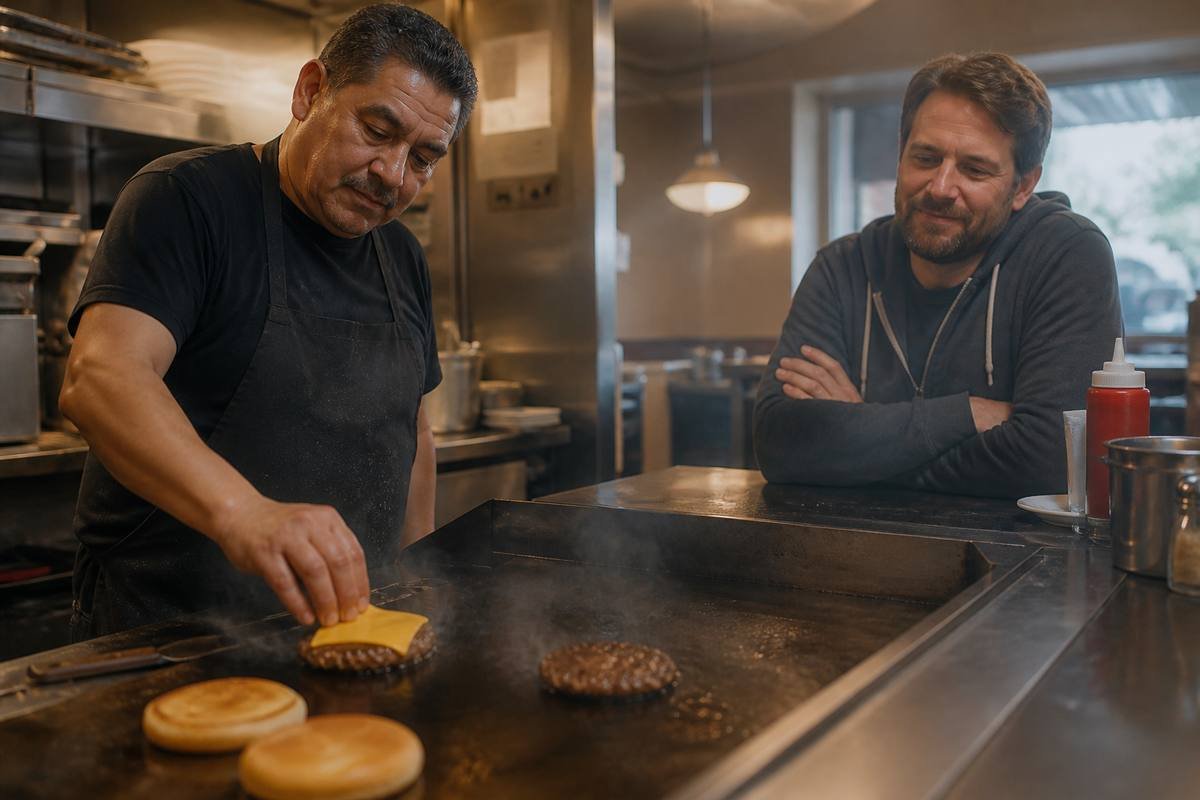
Every great invention gets one great improvement. The telephone got the dial, the guitar got electricity, and the hamburger, some three decades into its life, got a slice of cheese, and was never plain again. It is strange to remember that the two were ever separate, because to the modern American palate the cheeseburger is not a variation but the default; order “a burger” almost anywhere in the country and the counter will ask what cheese you want on it. Yet the cheeseburger has its own history, distinct from the hamburger’s, with its own disputed birthplaces, its own teenage inventor flipping meat at his father’s sandwich shop, its own trademark battle, and its own culinary logic that took most of a century to perfect. This is the biography of the sequel that outgrew the original: where the cheeseburger came from, why it works on the tongue the way it does, how one particular cheese conquered it, and how a Depression-era experiment became the most ordered restaurant item in the United States.
A Hamburger Walks Alone: The World Before Cheese
To appreciate the invention, picture the burger world of the early 1920s. The hamburger had spent its first decades clawing upward from disrepute, dogged by the meatpacking scandals and the suspicion of ground meat that White Castle had been founded, in 1921, specifically to defeat. The standard burger of the era was a small, thin patty, cooked hard on a griddle with onions, dressed with mustard and pickle, and sold for a nickel to workingmen in a hurry. Cheese, meanwhile, lived in a different neighborhood of the American diet, in sandwiches of its own, in rarebits and macaroni, but not on meat. Combining hot beef and melted cheese in a sandwich was not an obvious move; it was, by the logic of the time, redundant, two proteins doing one job.
The idea had to be stumbled into, and the beauty of the cheeseburger’s origin stories is that stumbling is exactly what they describe.
The Boy at the Griddle: Pasadena, 1926
The most widely told origin story belongs to Lionel Sternberger, a sixteen-year-old working the griddle at his father’s sandwich shop, The Rite Spot, on Colorado Boulevard in Pasadena, California, around 1926. The versions vary in their details, and their charm. In one, a hobo at the counter suggests the cook throw a slice of cheese on the hamburger he is frying, an anonymous genius who then vanishes from history. In another, young Lionel accidentally burns one side of a patty and drapes cheese over the damage to hide the evidence from his father, inventing an American icon in the act of covering up a mistake. In a third, he is simply an experimenting teenager with access to a griddle and a cheese drawer, which any parent of a sixteen-year-old will find the most plausible account of all.
Whatever happened at the griddle, the menu tells the rest. The Rite Spot began selling the creation under a name that proves how new the idea was: “The Aristocratic Burger: The Original Hamburger with Cheese.” The cheeseburger’s very first appearance in public came dressed in a tuxedo, marketed as a luxury upgrade of the workingman’s nickel sandwich, and at fifteen cents it cost half again the going rate. Los Angeles, then in the first bloom of its car culture and its roadside restaurant boom, was the perfect nursery, and the burger-with-cheese spread through Southern California’s stands and drive-ins over the following decade.
The Rivals: Louisville, Denver, and the Trademark Nobody Remembers
As with the hamburger itself, the cheeseburger has rival birthplaces, and they deserve their paragraphs. Kaelin’s Restaurant in Louisville, Kentucky, claims that Carl Kaelin put cheese on a hamburger in 1934, drawn, family legend says, by the “extra tang” it added to beef, and Kaelin’s has celebrated itself as the birthplace of the cheeseburger for generations; the restaurant’s sign long announced it to the city. And in Denver, Colorado, a drive-in called the Humpty Dumpty Barrel achieved something neither Pasadena nor Louisville managed: its owner, Louis Ballast, actually registered a trademark for the word “cheeseburger” in 1935. It stands among the great futile trademarks in commercial history, since Ballast never seriously enforced it and the word ran free within years, but Denver honors the site of the old drive-in with a granite marker, surely the only monument in America to a sandwich trademark.
The sensible reading of the three claims mirrors the hamburger’s own tangled origins: Pasadena has the earliest date and the strongest documentation for the invention, Louisville and Denver represent the idea’s independent arrival and commercial maturing, and the truth is that once ground beef, griddles, and American cheese shared a kitchen, the cheeseburger was inevitable everywhere. Some inventions have a single parent; the best ones have a generation of them.
| Year | Milestone | Place |
|---|---|---|
| 1926 | Lionel Sternberger’s “Aristocratic Burger” at The Rite Spot | Pasadena, California |
| 1934 | Kaelin’s Restaurant begins serving cheeseburgers | Louisville, Kentucky |
| 1935 | Louis Ballast trademarks “cheeseburger” | Denver, Colorado |
| 1948 | In-N-Out opens; cheeseburger central to menu | Baldwin Park, California |
| 1961 | McDonald’s cheeseburger a national standard | Nationwide |
| 1970s | Processed American slice becomes the default burger cheese | Nationwide |
| 2000s | Gourmet movement rehabilitates the cheeseburger as chef food | Nationwide |
Why Cheese and Beef Were Made for Each Other
The cheeseburger’s conquest was not marketing; it was chemistry, and the science explains why the combination felt less like an addition than a completion.
Beef is rich in the savory compounds that produce umami, the deep fifth taste. Aged and processed cheeses are loaded with glutamates, the very molecules that trigger umami most directly. When the two combine, they do not merely add together; they amplify, a phenomenon food scientists call umami synergy, the same effect that makes tomato and parmesan or mushrooms and soy sauce more than the sum of their parts. A cheeseburger literally tastes more intensely savory than its ingredients do separately, which is why the first bite of one reads to the brain as a louder, rounder, more complete version of a hamburger rather than a hamburger plus something.
Texture does the rest. A melted cheese slice is a layer of soft, salty fat that fills every crevice of a craggy griddled patty, moisturizes each bite, and glues patty to bun into a single structure. It buffers the palate against the char’s bitterness and the pickle’s acid, mediating the sandwich’s extremes like a diplomat. The cheeseburger is, in engineering terms, the hamburger with its rough edges gasketed, and once the country tasted the sealed version, the unsealed one became a special order.
The Slice That Won: How American Cheese Took the Crown
The cheeseburger’s biography contains a second, quieter revolution: the victory of one particular cheese. The early cheeseburgers of the 1920s and 1930s used what shops had, cheddar mostly, sometimes swiss. But cheddar has a flaw at the griddle: heated hard, its proteins clench and its fat weeps, breaking the slice into grease and grain. The solution had been invented, conveniently, just before the cheeseburger itself, when James L. Kraft patented his method of processed cheese in 1916, blending real cheese with emulsifying salts that hold fat and protein in a smooth, stable union at any temperature a burger can produce.
The individually wrapped slice, arriving mid-century, completed the conquest with logistics: uniform weight, uniform melt, no knife, no waste, no skill required at the height of a lunch rush. For the fast food industry being born in the 1950s, a cheese that behaved identically ten thousand times a day was not a compromise but a specification, and American cheese became to the cheeseburger what the sesame bun and the pickle chip were, a standard part. The gourmet decades that followed tried earnestly to unseat it, and the results are instructive: the celebrated burgers of the modern era, from cult drive-ins to chef-driven smash counters, overwhelmingly returned to the American slice after auditioning the fancier candidates, because on a thin, hot, fast patty, nothing else drapes, binds, and behaves as well. The food snob’s surrender to the orange slice is by now a standard chapter in every honest burger memoir.
That said, the cheeseburger’s later biography is enriched by its marriages: cheddar for sharpness on bacon builds, swiss over mushrooms, blue cheese crumbled into steakhouse-thick patties, pepper jack riding southwestern builds, pimento cheese melting into the burger’s southern accent. The American slice won the throne, but the court is large.
From Nickel Upgrade to National Default
The cheeseburger’s final act is its quiet takeover of the original. Through the fast food boom, the cheese option outsold plainness steadily until menus inverted; the cheeseburger became the baseline item, and “hamburger” the diminished special order, often the same sandwich minus a slice, priced barely lower. Industry counts of menu mentions and orders have ranked the cheeseburger among the most ordered restaurant foods in the country year after year, and the national appetite runs to billions of them annually. The sandwich acquired its own holiday, National Cheeseburger Day on September 18, celebrated by chains with promotions and by the rest of the country with lunch. The double cheeseburger became the value menu’s anchor and the smash burger movement’s canvas; the bacon cheeseburger became a genre unto itself; and the Aristocratic Burger’s fifteen-cent pretension came true in the end, with dry-aged, truffled, gold-leafed cheeseburgers commanding steakhouse prices in every American food capital.
It is worth pausing on how rare this arc is. Most food upgrades stay upgrades, options on a menu, footnotes to the original. The cheese did something else: it absorbed the hamburger, redefined the category, and made the unimproved version the exception, all within living memory of its invention. Lionel Sternberger died in 1964, having watched a teenager’s griddle experiment become the country’s default lunch.
The Sequel That Became the Story
Somewhere in Pasadena a hundred years ago, give or take a hobo’s suggestion or a burned patty, a slice of cheese landed on a hamburger and refused to leave. The combination needed no committee and no campaign; it needed only tasting. Chemistry made it inevitable, Kraft’s emulsifiers made it reliable, the drive-ins made it fast, and the American appetite made it permanent, until the sandwich with the borrowed name, ham-burger with cheese, became more American than either parent. The hamburger is the invention; the cheeseburger is the perfection, the rare sequel that the audience, by billions of orders a year, has ruled better than the original. Raise the next one you eat slightly toward the west, in the direction of a vanished sandwich shop on Colorado Boulevard, in honor of the sixteen-year-old at the griddle, patron saint of every cook who ever covered a mistake with cheese and discovered it was not a mistake at all.
Leave a Reply