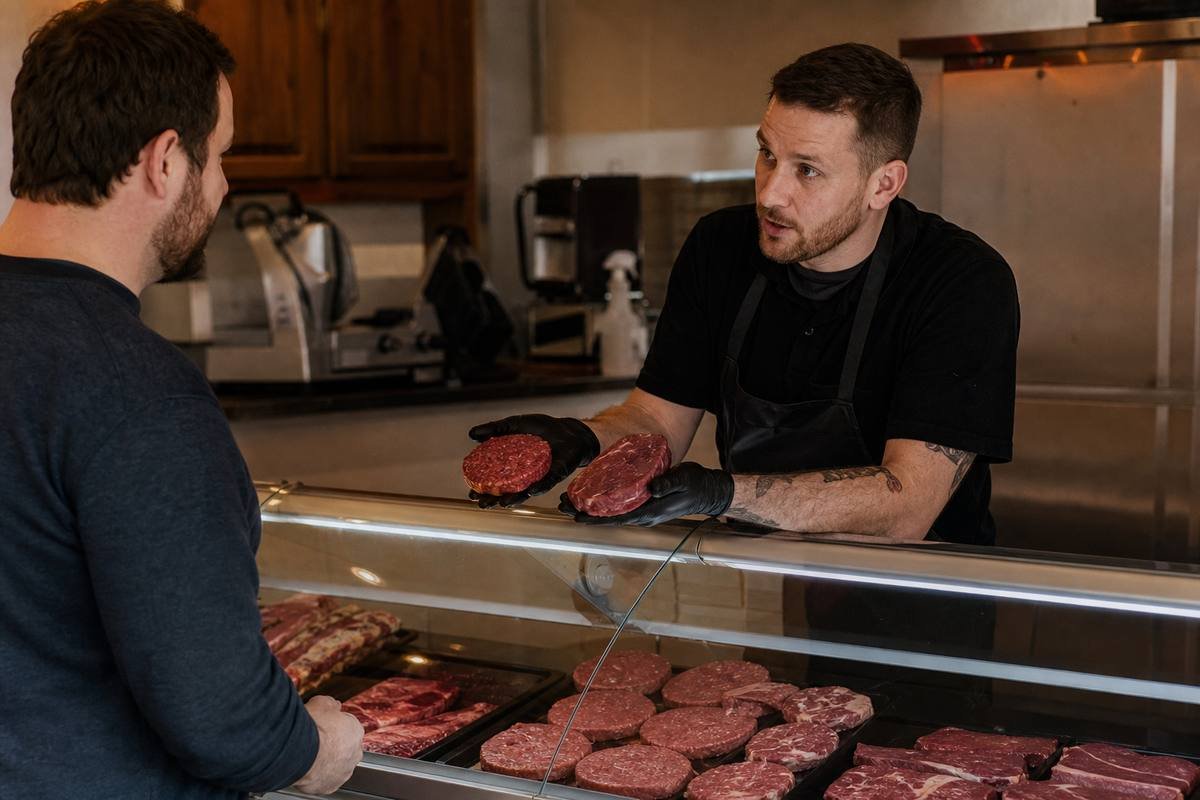
Stand at a good butcher counter and ask for burger meat, and you will face a wall of vocabulary that did not exist at the supermarket a generation ago. Grass-fed. Grain-finished. Certified Angus. American Wagyu. Dry-aged blend. Prime, Choice, Select. Organic, pasture-raised, no added hormones. Each label carries a price premium, each implies a promise, and almost nobody buying a pound of ground beef on a Saturday morning can say with confidence what any of them actually deliver inside a bun. This article decodes the entire wall. It explains how cattle raising actually works in America, what the labels legally mean and what they merely suggest, which premium upgrades genuinely change how a burger tastes, and which ones spend your money on words. By the end, you will know exactly what to ask for at the counter, and, just as important, what to stop paying extra for.
How American Beef Actually Gets Raised
The labels make sense only against the real backdrop of cattle raising, which is less divided than the marketing implies. Here is the truth that surprises most shoppers: virtually all American beef cattle, including conventional grain-fed animals, spend most of their lives eating grass on pasture. A typical animal grazes with its mother, then on open range, for twelve to sixteen months. What the labels actually describe is the ending.
Conventional cattle spend their final four to six months at a feedlot, eating a dense ration of corn, grain, and forage. This finishing period is where beef gains most of its marbling, the flecks of fat inside the muscle, and where American beef acquires the rich, buttery, slightly sweet flavor the world associates with it. Grass-fed and grass-finished cattle skip the feedlot and eat grass and forage for their entire lives, growing more slowly, finishing leaner, and developing a distinctly different flavor, cleaner, more mineral, sometimes described as grassy or gamey, closer to the taste of beef in Argentina or New Zealand than to the American steakhouse profile.
Neither ending is a secret shame or a moral triumph in itself; they are different products. But the distinction matters enormously for burgers specifically, and in a way that cuts against the premium pricing, as we will see.
The Label Decoder
Before tasting, it pays to know what the words on the package legally commit to, because they range from rigorous to nearly meaningless.
Grass-fed, when backed by a credible certification, means the animal ate grass and forage after weaning, with no grain. The term became muddier after the federal government withdrew its official standard in 2016, so third-party seals such as American Grassfed Association carry the real weight. Grass-finished emphasizes that grass continued to the end, closing the loophole of grass-fed animals finished on grain. Organic governs the feed (organically grown, no synthetic pesticides) and prohibits antibiotics and added hormones, but says nothing about grass versus grain. No added hormones is meaningful for beef; no antibiotics ever means what it says; and natural, one of the great triumphs of food marketing, means only that the meat contains no artificial ingredients and was minimally processed, which describes essentially all fresh ground beef ever sold. Angus refers to a cattle breed known for reliable marbling, and Certified Angus Beef is a genuine quality program with marbling standards, though at the grinding stage its advantages narrow. Pasture-raised, on beef, is nearly redundant given how cattle are actually raised, and buyers should treat it as ambiance rather than information.
Then there are the federal grades, Prime, Choice, and Select, which measure exactly one thing: marbling in the ribeye muscle of the carcass. Prime is the fattiest and most marbled, Choice the broad middle, Select the leanest. The grades exist for steaks, and here is the first money-saving insight of this article: for ground beef, grade barely matters, because the grinder controls fat directly. An 80/20 grind made from Select cattle and an 80/20 grind made from Prime cattle contain, by definition, the same twenty percent fat. What Prime offers a steak, guaranteed internal fat, the burger maker achieves with a scale and a fat trim. Paying a Prime premium for meat you are about to grind is, mostly, paying for a word.
Grass-Fed Versus Grain-Fed in the Bun: An Honest Tasting
The grass-versus-grain question is where ideology and taste get tangled, so it is worth being blunt about what each actually delivers in burger form.
Grain-finished beef makes what most Americans recognize as the perfect burger: rich, juicy, sweet-savory, with abundant soft fat that renders on the griddle and bastes the patty. Its fat melts at a lower temperature, which is why the burger feels lush rather than waxy. If your reference point is the best cheeseburger of your life, it was almost certainly grain-finished beef.
Grass-fed beef makes a different burger, leaner, firmer, with a bolder, more mineral, more complex flavor that some eaters love and others find aggressive. It carries a nutritional edge, modestly more omega-3 fatty acids and certain vitamins, though the absolute quantities are small; beef is not a fish substitute on any diet. Its environmental story is genuinely debated in both directions, with grazing advocates citing soil health and pasture carbon while critics note grass-fed cattle live longer and emit more methane per pound. Honest summary: buy grass-fed for its flavor and its farming philosophy if those speak to you, not because a label converted a burger into a health food.
The practical problem with grass-fed burgers is simply fat. Much grass-fed ground beef sells at 85/15 or leaner, and lean grass-fed patties overcook in a blink, turning dry and livery. The fixes: seek out grass-fed grinds at 80/20, cook a shade less done than you would grain-fed, and never press. Better yet, if your butcher grinds to order, ask for grass-fed chuck with added fat trim. The flavor is the point; do not let leanness sabotage it.
The Premium Tier: Wagyu, Dry-Aged, and Heritage Breeds
Above the everyday choices sits the luxury shelf, and it deserves a clear-eyed look, because burger economics are strange at the top.
American Wagyu, crossbred from Japanese cattle genetics and American herds, carries extraordinary marbling with fat that melts at unusually low temperatures, nearly at body heat, which produces a distinctively silky, rich mouthfeel. In a thick, medium-rare pub burger, Wagyu genuinely tastes different, decadent in a way standard chuck is not. In a thin, well-done smash patty buried under cheese and sauce, most of that difference vanishes, and the money with it. True imported Japanese Wagyu ground into burgers is, frankly, a stunt; its magic is architectural, the marbling of an intact steak, and the grinder demolishes the architecture.
Dry-aged beef spends weeks in controlled cold storage, losing moisture and developing deep, nutty, funky flavors through enzymatic action. A blend containing dry-aged trim, which many serious burger restaurants use, adds a genuine and recognizable savory intensity, one of the few premium flavors that survives grinding completely intact. If your butcher sells a dry-aged burger blend, it is among the upgrades most worth trying once.
Heritage breeds and single-farm beef vary too much for a general verdict, but they offer something the commodity system cannot: traceability and character. A burger from a named farm’s dry-aged Hereford chuck will not automatically beat the supermarket, but it will taste like somewhere, and for many eaters that is worth the difference.
The table below puts the whole market in one view, with honest burger-specific verdicts.
| Beef Type | Typical Price per Pound (Ground) | Flavor in a Burger | Worth It for Burgers? |
|---|---|---|---|
| Conventional 80/20 chuck | 5 to 7 dollars | Classic, rich, reliable | The benchmark; always yes |
| Certified Angus 80/20 | 6 to 8 dollars | Marginally richer | Sometimes; small difference |
| Organic grain-fed | 8 to 10 dollars | Same profile as conventional | For the farming, not the flavor |
| Grass-fed 85/15 | 8 to 11 dollars | Bold, mineral, leaner | Yes, if you like the flavor and cook carefully |
| American Wagyu blend | 12 to 18 dollars | Silky, very rich | In thick patties, yes; in smash burgers, no |
| Dry-aged blend | 12 to 20 dollars | Deep, nutty, intense | Yes; the rare premium that grinding preserves |
| Japanese Wagyu ground | 30 dollars and up | Rich but wasted | No; buy the steak instead |
What Actually Matters: A Buyer’s Hierarchy
Strip away the marketing and the factors that determine burger quality rank in a clear order, and the order is liberating, because the top of the list is cheap.
First, fat percentage, the undisputed king. Twenty percent fat in the grind matters more than breed, grade, certification, and price combined. Second, freshness of grind; beef ground today at the counter beats premium beef compressed in plastic for ten days, every time, on both texture and flavor. Third, the cut composition, with chuck as the foundation and brisket or short rib as worthwhile flourishes. Fourth, and only fourth, the raising system, grass versus grain, which changes the flavor’s character rather than its quality. Fifth, everything else on the label.
This hierarchy produces the practical shopping strategy. For everyday burgers: fresh-ground 80/20 chuck, whatever the sign says about breed or grade, from wherever grinds it freshest. For a weekend upgrade: ask the butcher to grind chuck with brisket, or buy the dry-aged blend if one exists. For the curious: a package of genuinely certified grass-fed at 80/20, cooked gently, tasted side by side against grain-fed, an education for a few dollars. And for a once-a-year event burger: American Wagyu, formed into thick six-ounce patties, cooked medium-rare with a thermometer, dressed with restraint, because at that price the beef is the topping.
The Bigger Picture
There is one more reason to learn this vocabulary, beyond taste and thrift. Ground beef is where the entire American cattle economy converges; more than half the beef the country eats goes through the grinder, from dairy cows to Prime trim, and the choices of burger buyers, multiplied by fifty billion sandwiches a year, shape how the national herd is raised more than any steakhouse ever will. Shoppers who know the difference between a certification and a vibe, who reward the practices they actually value rather than the adjectives that merely sound like values, cast the beef industry’s most numerous votes.
So the next time you face the wall of labels, walk up with the hierarchy in mind. Fat first, freshness second, cut third, philosophy fourth, poetry last. Ask the butcher what came in today and what they would grind for themselves. The wall of words shrinks quickly under those two questions, and what remains is the thing the labels were always circling and never quite saying: a pound of honest, fatty, freshly ground beef, on its way to the best sandwich America ever invented.
Leave a Reply