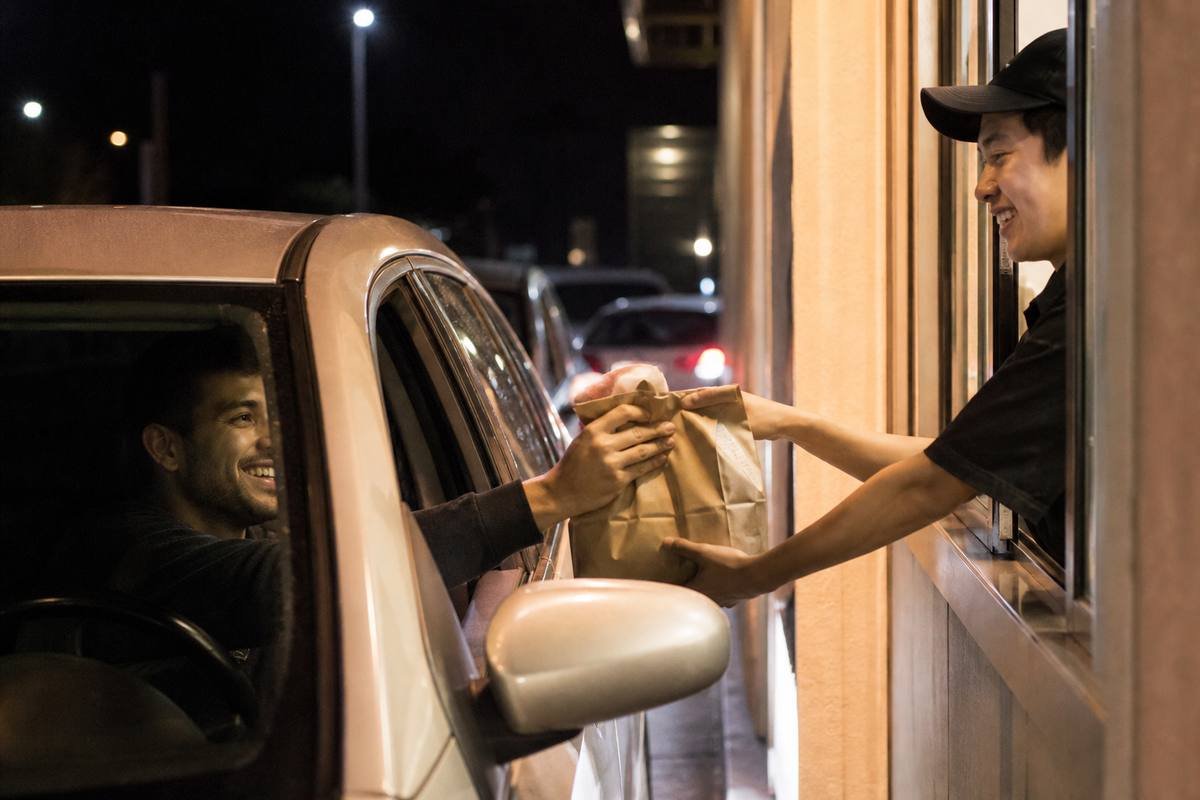
The most American sentence ever spoken may be the one that crackles through a weatherproof speaker a hundred thousand times a minute, from Bangor to Bakersfield: “Welcome, can I take your order?” No other country fused its food and its transportation so completely, and no food rode the automobile further than the burger. The drive-in, the carhop, the speaker box, the pick-up window, the double lane, the app that knows your order before your turn signal does, every one of these inventions was built, first and foremost, to move a hamburger from a griddle into a moving car without anyone leaving their seat. This article tells that story in full: how a Texas pig stand accidentally invented eating in cars, how roller-skating carhops became the defining image of an era, how a burger joint with two-way speakers in California changed the physical shape of American cities, and how the drive-through evolved into the billion-dollar science of seconds it is today.
Before the Window: America Discovers Eating in Cars
The automobile and the hamburger grew up together, born within a couple of decades of each other and made for each other in ways neither industry understood at first. By the early 1920s, cars had stopped being toys for the rich and become the possession of ordinary families, and ordinary families discovered a new national pastime: driving around. What they lacked was anywhere to eat that respected the car itself.
The answer arrived in Dallas, Texas, in 1921, the same remarkable year White Castle opened in Wichita. A tobacco magnate named J.G. Kirby, backed by a physician named Reuben Jackson, opened a roadside stand called the Pig Stand, selling barbecue pork sandwiches to motorists who never left their vehicles. Kirby’s reported justification deserves its place in business history: “People with cars are so lazy they don’t want to get out of them to eat.” Young men ran to the running boards of arriving cars, took orders, and ferried food back on trays. The Pig Stand chain spread across Texas and California, and along the way its locations pioneered an astonishing share of roadside vocabulary, including, by most accounts, the first true drive-through window in 1931, where a motorist could collect food through an opening in the wall without stopping the engine long.
The burger colonized this new format almost immediately, for the same reasons it had conquered the lunch counter: it was fast to cook, easy to hold in one hand with the other on the wheel, and cheap enough for a family of five. By the 1930s, drive-in burger stands dotted the highways of the South and West, and a new American ritual, dinner in the front seat, was fully underway.
The Carhop Era: Dinner as Theater
The drive-in’s golden age, from the late 1930s through the 1950s, turned burger service into performance. The carhop, so named, by most tellings, because servers hopped onto the running boards of slowing cars to claim customers before rivals could, became one of the era’s iconic jobs. The best drive-ins put their carhops on roller skates, dressed them in uniforms ranging from military-crisp to space-age, and staged what amounted to choreography in the parking lot: trays balanced through traffic, window-mounted with a practiced flip, milkshakes delivered at speed.
The physical engineering of the era was charming and ingenious. The window tray, clamping to a half-rolled-down pane of glass, was patented and perfected; canopies spread over parking rows so families could eat through summer rain; speaker systems eventually let customers order from posts beside their parking spots at chains like Sonic, which was founded in Oklahoma in the 1950s under the name Top Hat and survives today as the last great national carhop chain, skates and all.
The drive-in was never really about efficiency, and that was its glory and its doom. It was social space, the teenage commons of postwar America, immortalized in American Graffiti and Happy Days, the place where the car, the burger, the milkshake, and the radio fused into a single experience of freedom. Families came for convenience, but teenagers came to circle the lot, to see and be seen, to spend two hours over one order of fries. And therein lay the business problem: a parking spot occupied for two hours by a carful of teenagers nursing cherry limeades is, from an operator’s cold perspective, a griddle’s worth of unsold burgers. As land values rose and labor costs climbed, the leisurely drive-in economics stopped working, and the industry began searching for a format that kept the car but lost the loitering.
The Speaker Box Revolution: In-N-Out and the True Drive-Through
The search ended in a suburb of Los Angeles in 1948, at a tiny burger stand with no parking lot theatrics at all. Harry and Esther Snyder’s first In-N-Out Burger in Baldwin Park was, by the founders’ deliberate design, something new: a “drive-thru” where the customer pulled up to a two-way speaker box, an innovation Harry Snyder built himself, spoke an order into it, and collected the food at a window moments later without a carhop, a tray, or a parking spot. The name said everything. You drove in; you drove out. The burger had shed its last ceremony.
The format’s superiority took a surprisingly long time to conquer the industry. McDonald’s, busy perfecting its walk-up and dine-in systems, did not open its first drive-through until 1975, in Sierra Vista, Arizona, and the origin story is perfect: the window was created to serve soldiers from nearby Fort Huachuca, who were forbidden by regulation from leaving their vehicles in fatigues. Necessity, in uniform, drove up to the wall, and McDonald’s cut a hole in it. Wendy’s, founded in 1969, had made the pick-up window standard from nearly the beginning, and by the 1980s the race was fully on. The results reshaped the physical form of American fast food: buildings shrank, dining rooms became afterthoughts, lots were engineered around the queue, and the industry’s center of gravity moved permanently to the window. Today roughly two-thirds or more of American fast food revenue flows through drive-through lanes, a share that spiked even higher during the pandemic years, when the window briefly became the only safe restaurant in the country and chains discovered just how much of their business could survive on wheels alone.
The Science of Seconds
What began as a hole in a wall is now among the most obsessively optimized systems in commerce, and the optimization is all about the burger’s oldest promise: speed. The industry’s scoreboard is published annually in drive-through performance studies that chains follow like league standings, timing thousands of visits to the second. The numbers tell a story of relentless engineering: total service times averaging around five minutes, order accuracy in the mid-eighties to low-nineties as a percentage, and perennial speed champions among chains built around simple menus, with Taco Bell and Carl’s Jr. frequently sprinting ahead of the pack while more complex menus pay for their variety in seconds.
The tactics behind the numbers have grown wonderfully elaborate. Double and triple lanes merge like freeway interchanges. Timers hang in kitchens, counting every car aloud. Menu boards went digital and began rearranging themselves by time of day, weather, and what the kitchen could produce fastest at that moment. Human order-takers with tablets walk the queue during rush, a technique known as line-busting, borrowed by the burger business from theme parks. Kitchens are laid out so the burger’s assembly line points toward the window like a river toward the sea. Chick-fil-A, whose queues are civic phenomena requiring traffic management, turned its drive-through into a logistics discipline studied by business schools. And the newest frontier is conversational: chains have piloted and deployed artificial intelligence voices at the speaker box, machines taking burger orders in the same lanes where teenagers once shouted at squawking metal grilles, with dedicated mobile-order lanes and license-plate recognition promising a near future in which the window knows the car, the order, and the payment before the driver says a word.
The milestone chart of the whole century runs as follows.
| Year | Milestone | Where |
|---|---|---|
| 1921 | First drive-in restaurant, the Pig Stand | Dallas, Texas |
| 1931 | First drive-through window, Pig Stand location | California |
| 1948 | First two-way speaker drive-thru, In-N-Out | Baldwin Park, California |
| 1950s | Sonic builds the carhop-and-speaker drive-in chain | Oklahoma |
| 1969 to 1971 | Wendy’s makes the pick-up window standard | Ohio |
| 1975 | First McDonald’s drive-through, for soldiers | Sierra Vista, Arizona |
| 2020 | Pandemic pushes drive-through to record share of sales | Nationwide |
| 2020s | AI ordering and mobile-order lanes deployed | Nationwide |
What the Window Says About Us
It is easy to treat the drive-through as a punchline about American laziness, and Kirby the Pig Stand founder made the joke himself a century ago. But the window rewards a more generous reading. The drive-through is what a restless, spread-out, working country built when it needed dinner between the second shift and the school pickup; it is the infrastructure of lives lived in motion, and its finest hours prove the point. During the pandemic, the lane was a lifeline, feeding a locked-down nation through a gap in the wall. In towns too small for a sit-down restaurant to survive, the window endures. The minivan at the speaker box at 9 p.m., ordering four different burgers four different ways, is not a portrait of laziness; it is a family getting fed on a Tuesday, which was always the burger’s truest job.
And the format keeps its romance in the corners. Sonic’s carhops still skate. In-N-Out’s original speaker-box lane still runs in Baldwin Park, steps from where Harry Snyder wired the first one by hand. Classic drive-ins survive as summer pilgrimage sites across the Midwest, window trays and all, selling the 1955 experience alongside the burgers. The century of the drive-through window built the modern burger business, reshaped the architecture of every commercial strip in America, and embedded a piece of car-culture theater into daily life so deeply that nobody notices it anymore, which is what total victory looks like. The next time you idle at the speaker and the tinny voice welcomes you, consider offering the window a moment of respect. You are participating in a hundred-year-old invention, ordering the hundred-year-old sandwich it was built to carry, in the country that decided, earlier and more enthusiastically than any other, that dinner should be able to do thirty miles an hour.
Leave a Reply