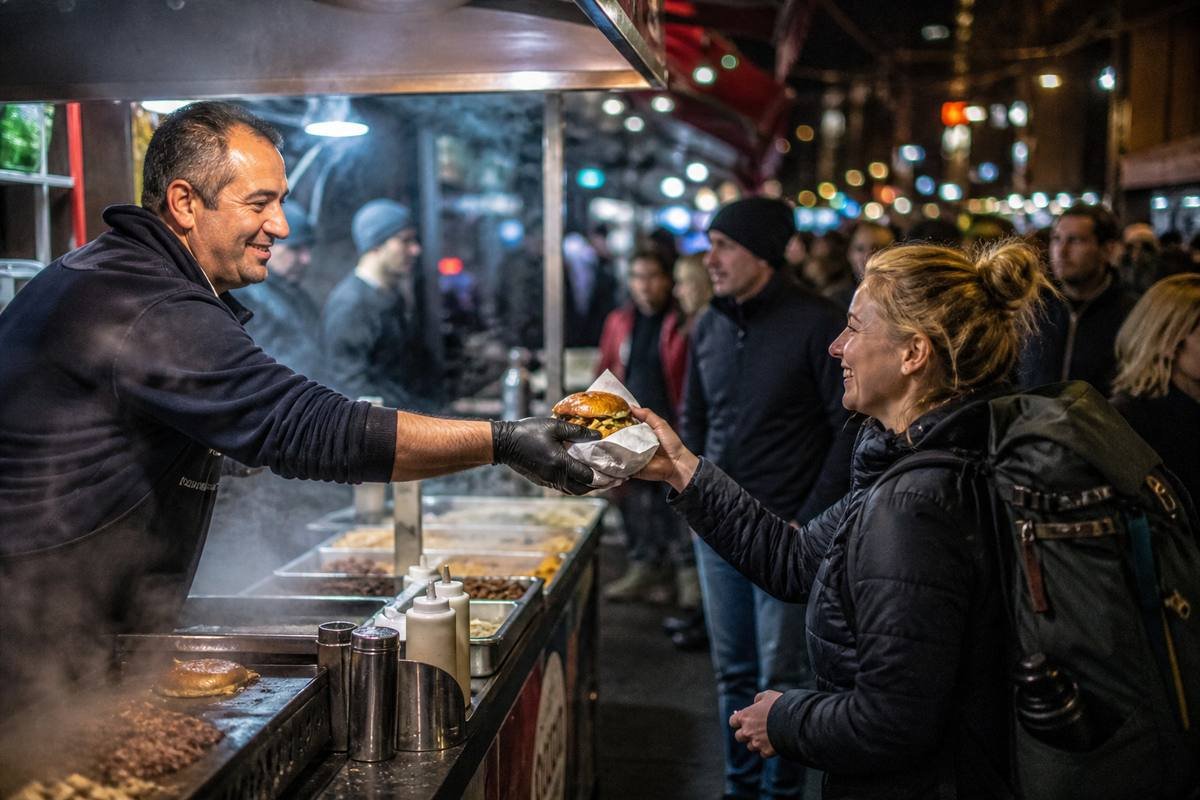
In Tokyo, a burger arrives between two pressed discs of grilled rice. In Sydney, it is not considered complete without a slice of pickled beetroot and, in the classic milk-bar style, a fried egg and a ring of pineapple. In Mexico City, the hamburguesa comes wrapped in ham and slathered with avocado; in Copenhagen, chefs plate it with fermented condiments and charge accordingly; in New Delhi, the best-selling version at the world’s most famous burger chain contains no beef at all, and never has. The hamburger left America decades ago carrying a flag, and like every traveler, it was changed by the journey. This article follows the burger around the world: how it spread, why it became the single most contested symbol of American influence ever served on a plate, what every region did to make it their own, and what those foreign reinventions are now teaching the country that invented it.
The Export Begins: GIs, Golden Arches, and the Cold War Cheeseburger
The burger’s first passports were military. American soldiers carried their food culture with them through the Second World War and the long deployments that followed, and burger stands sprouted around bases from West Germany to Okinawa, feeding homesick GIs and curious locals at the same counters. Japan’s distinctive burger culture, which would eventually produce some of the finest burgers on earth, traces directly to the American presence in Sasebo and Yokosuka; the “Sasebo burger” is now a proud regional specialty of the very city where sailors first taught local cooks the recipe.
The corporate wave came next, and its landmark dates read like diplomatic history. McDonald’s crossed its first border into Canada in 1967, reached Japan in 1971, where founder Den Fujita famously promised that hamburgers would transform the Japanese, and planted its most symbolic flag on January 31, 1990, when the Moscow Pushkin Square location opened to a line of an estimated thirty thousand Soviet citizens, the largest opening-day crowd in company history. That Moscow queue became one of the defining images of the Cold War’s end: whatever the politics, ordinary people would stand for hours in the snow for the taste of the other side. The burger was no longer a sandwich. It was a statement, and everyone on every side of every argument about America understood it that way, which is why protesters have smashed McDonald’s windows on every continent and why economists measure currencies with the Big Mac. No food has ever carried more symbolic freight.
The Great Localization: Everybody Rewrites the Burger
The empire of the burger, however, turned out to be nothing like an empire of uniformity. The chains discovered quickly that the world would take the format and reject the script, and the localized menus they built are a graduate course in cultural adaptation.
India is the most dramatic case. With the majority of the population avoiding beef for religious reasons, McDonald’s entered the market in 1996 with a menu unlike any in its history: no beef, no pork, separate vegetarian kitchens, and a flagship called the McAloo Tikki, a spiced potato-and-pea patty in a bun that has become one of the company’s best-selling items anywhere. The world’s most famous hamburger chain thrives in India by, essentially, not selling hamburgers, and the lesson was not lost on the industry.
Japan turned the burger into a canvas. The teriyaki burger, glazed sweet-savory and now standard across every Japanese chain, was only the beginning; MOS Burger, the beloved homegrown competitor founded in 1972, invented the rice burger, replacing the bun entirely with toasted patties of pressed rice, and fills its burgers with everything from grilled eel to kinpira vegetables. Japanese burger craft eventually flowed back westward, with Tokyo-style smashed-and-lacquered burgers and their meticulous construction influencing a generation of American chefs.
Australia waged and won a war over vegetables. The “burger with the lot,” the milk-bar classic, stacks beetroot, fried egg, pineapple, and bacon, and Australians regard the beetroot in particular as non-negotiable national heritage; when American chains initially omitted it, the public outcry forced it onto menus. To this day, an Australian abroad, confronted with an American burger, will note the absence of beetroot with the weary patience of a missionary among the unconverted.
Around the rest of the map, the pattern repeats with local accents. Mexico’s street hamburguesas wrap the patty in ham and pineapple and finish it with avocado and chipotle mayo. The Middle East and South Asia built vast halal burger cultures, and London’s gourmet halal smash burger scene is now among the most vibrant anywhere. Korea folded the burger into its fried-chicken-and-gochujang universe and produced, at the extreme, black-bunned and bulgogi-topped inventions that go viral on schedule. France, which intellectually resisted the burger for decades as the very symbol of culinary barbarism, quietly surrendered so completely that the burger became the best-selling dish in French restaurants, outselling the jambon-beurre in its own country, though naturally it arrives there with raclette, shallot confit, and a knife and fork.
| Country | Signature Burger Move | What It Reveals |
|---|---|---|
| Japan | Teriyaki glaze; rice buns at MOS Burger | The bun itself is negotiable |
| India | McAloo Tikki potato patty; no beef nationwide | The patty is negotiable too |
| Australia | Beetroot, egg, and pineapple, “the lot” | Toppings become national identity |
| Mexico | Ham-wrapped patty, avocado, chipotle | The burger absorbs the torta |
| France | Raclette and confit, eaten with cutlery | Resistance ends in refinement |
| South Korea | Bulgogi glazes, extravagant builds | The burger as pop culture object |
| Middle East | Halal smash burger boom | The format crosses every dietary line |
The table’s last column is the real story: every element Americans consider essential, the beef, the bun, even eating it with your hands, has been successfully replaced somewhere, and the result still reads unmistakably as a burger. The sandwich’s deepest invention was never a recipe. It was a format, patty-in-bread, infinitely translatable, and formats travel lighter than recipes.
The Counter-Invasion: What the World Sent Back
For the burger’s first fifty international years, the flow ran one direction. Then, around the 2010s, the current reversed, and the American burger scene became one of the world’s great importers.
The clearest arrival is the halal and Pakistani-influenced smash burger movement in American and British cities, where spiced chutneys, green sauce, and chaat-inspired toppings meet the crispy-edged patty. Korean flavors, gochujang mayo, kimchi in place of pickles, arrived so thoroughly that they now appear on chain menus in middle America. The Oklahoma onion burger technique was rediscovered partly through international burger obsessives documenting it online, a curious case of a domestic tradition re-imported through foreign enthusiasm. Japanese standards of construction, the tidy wrap, the engineered bite, the reverence for the bun’s softness, quietly raised expectations in high-end American burger kitchens. And the smash burger boom itself became a genuinely global conversation, with celebrated practitioners in London, Dubai, and Sydney trading techniques with American cooks in real time, the first burger movement in history with no single national home.
Meanwhile the international chains came calling on America itself. Filipino giant Jollibee opened American locations to lines around the block; MOS Burger and other Asian chains established beachheads; and the American diner could suddenly, in a single city, eat the burger as reinterpreted by half the world without a passport. The invention had completed the loop: exported as a symbol of America, rebuilt abroad in a hundred images, and returned home as a mirror.
What the Journey Teaches
It is tempting to tell the burger’s global story as a fable about American power, and for a while it genuinely was one; the Moscow line of 1990 was not standing in the snow for ground beef. But the longer story the burger tells is nearly the opposite of cultural conquest. Everywhere the sandwich landed, the locals took it apart, kept the format, and refilled it with themselves, potato in Delhi, rice in Tokyo, beetroot in Melbourne, raclette in Lyon, and the burger accepted every renovation without losing its name. The most American thing about the hamburger, it turns out, is not the beef or the bun but the openness of the design, the same quality that let a German immigrant’s chopped steak become a Kansas slider, a Depression onion burger, a Minneapolis cheese bomb, and a California drive-through icon within a single country. The world did to the burger exactly what America had already done to it, which is to say, whatever it wanted.
For the home cook and the traveler, the practical inheritance is a to-do list. Try a teriyaki glaze on a smash patty and understand Japan’s point immediately. Put a slice of pickled beetroot on your next backyard cheeseburger before judging Australia. Seek out the halal smash burger joint in your city, order whatever the green sauce is, and taste the newest chapter of an American story being written by cooks whose grandparents never saw a drive-in. The burger left home a century ago and never stopped traveling, and the finest thing about its journey is that every mile of it, eventually, ends up back on an American plate, asking the country that started it all the burger’s oldest and best question: what do you want on it?
Leave a Reply