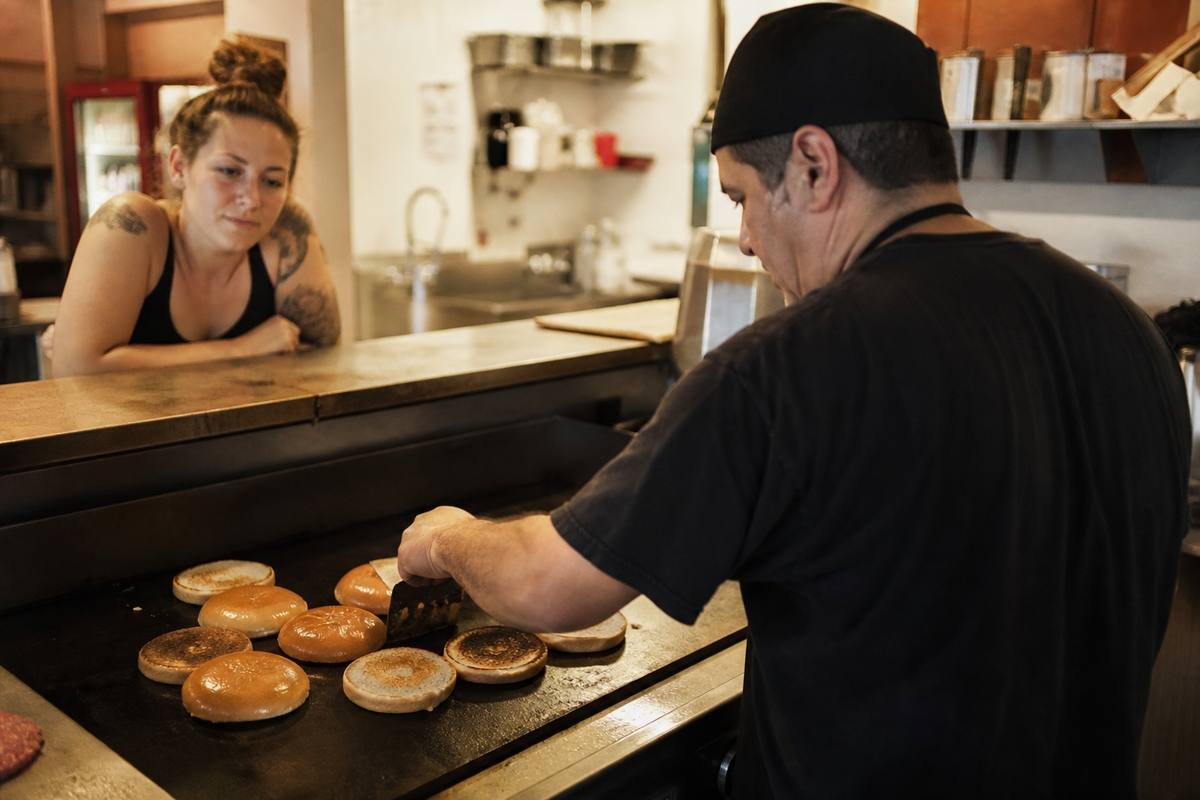
Consider the injustice at the heart of every burger conversation. Enthusiasts will argue for an hour about grind ratios and cheese chemistry, they will drive across state lines for the right griddle technique, and then they will hand all of that carefully engineered beef to whatever eight-pack of pale, gassy supermarket bread happened to be on sale. The bun is half of every bite, the first thing your hands touch and the last flavor on your palate, and it is the most neglected component in American burger cooking. It is also the easiest to fix. This article gives the bun its overdue moment: what a great bun actually needs to do, an honest ranking of every major style from potato roll to pretzel, the transformative and nearly free habit of proper toasting, and, for the ambitious, a walk through baking a batch at home that will outclass anything in the bread aisle.
What a Bun Is Actually For
Before comparing styles, it helps to define the job, because a burger bun has four distinct responsibilities, and they pull against each other.
First, structure. A bun is a load-bearing element that must survive a six-ounce patty, melted cheese, juices, sauce, and wet vegetables for the full ten-minute life of the sandwich without disintegrating. Second, tenderness. The bun must compress easily when bitten, because a bun tougher than its patty squeezes the fillings out the back of the sandwich with every bite, the engineering failure behind most burger-eating accidents. Third, proportion. The bread should roughly match the patty in both diameter and substance; a towering bakery roll buries a modest patty in dough, while a flimsy disk vanishes under a half-pound pub burger. Fourth, flavor, and here restraint wins. The bun should taste gently sweet, faintly buttery, and mostly quiet, a supporting actor that makes the beef sound better.
The tension is obvious: structure demands sturdiness while tenderness demands softness, and every bun style on the market is a different answer to that contradiction. Some answers are much better than others.
The Field Guide to Bun Styles
The Potato Roll: The People’s Champion
If this article had to be compressed into one sentence, it would be this: buy potato rolls. The potato roll, with Martin’s of Pennsylvania as its most famous maker, solves the structure-tenderness contradiction better than any other commercial bread, and its dominance of the modern burger world is total. Shake Shack builds on Martin’s rolls. Countless acclaimed smash burger joints refuse to open in markets where they cannot source them.
The secret is the potato itself. Potato starch absorbs and holds far more moisture than wheat starch, so the crumb stays soft and springy for days, and the potato interferes with gluten development just enough to keep the bite tender while the roll remains structurally intact. The flavor is mildly sweet and faintly buttery, the color a cheerful gold. If the potato roll has a flaw, it is smallness; its standard size suits three-to-five-ounce patties and double smash stacks, though larger versions exist for pub builds.
The Brioche: The Gourmet Standard
Brioche, the French enriched bread heavy with butter and eggs, became the official bun of the 2010s gourmet burger boom, and it earned the role honestly: the flavor is rich, the crumb is fine and tender, and the glossy, deep-brown dome makes every burger photograph like a menu cover. But brioche carries real trade-offs. All that butter makes the crumb delicate, and a cheap brioche, of which the supermarket sells many, collapses into sweet mush under a juicy patty. Genuine bakery brioche also risks upstaging the beef; a very rich bun plus a very rich patty plus mayonnaise-based sauce can push a burger past indulgent into exhausting. Brioche rewards restraint elsewhere in the build and demands a serious toasting.
The Sesame Seed Bun: The Classic
The standard sesame-topped white bun is the taste of the twentieth-century American burger, the bun of backyards and drive-ins, and nostalgia is genuinely part of its value. Quality varies enormously: the good versions, from in-store bakeries, are fresh, squishy in the right way, and pleasantly wheaty, with the sesame adding a whisper of nuttiness. The bad ones, and the cheapest eight-packs are reliably bad, taste of nothing and dissolve on contact with juice. A fresh bakery sesame bun, toasted, remains a completely honorable choice for a classic grilled backyard burger.
The Pretzel Bun, the Ciabatta, and the Overachievers
The specialty buns deserve a fair hearing and firm limits. The pretzel bun brings a handsome mahogany crust, a salty tang, and real chew, and it pairs beautifully with beer-friendly builds, cheddar, caramelized onion, and mustard, but its density violates the tenderness rule; against a soft patty, the pretzel bun wins every bite, and the burger loses. Ciabatta and focaccia, refugees from the sandwich world, are worse offenders, their tough crusts and irregular holes leaking juice and shredding the roofs of mouths. The English muffin, by contrast, is a sleeper hit for thin diner-style patties, its griddled crispness and nooks made for catching juice. And the humble white “hamburger bun” from the bread aisle should be understood as what it is: acceptable scaffolding in an emergency, and never once anyone’s favorite part of the sandwich.
The rankings condense as follows.
| Bun Style | Structure | Tenderness | Flavor | Best Use |
|---|---|---|---|---|
| Potato roll | Excellent | Excellent | Gently sweet | Nearly everything, especially smash burgers |
| Fresh brioche | Good | Excellent | Rich, buttery | Gourmet builds, pub burgers |
| Bakery sesame | Good | Good | Classic, wheaty | Backyard grilled burgers |
| Pretzel bun | Excellent | Poor | Salty, malty | Sturdy pub burgers, sparingly |
| English muffin | Good | Good | Toasty, tangy | Thin diner-style patties |
| Ciabatta | Excellent | Poor | Crusty, open | Not recommended for burgers |
| Cheap white bun | Poor | Fair | Minimal | Emergencies only |
Toasting: The Cheapest Upgrade in Burger Cooking
Here is the highest-return sixty seconds in this entire article: toast the bun, every time, without exception. Toasting does three jobs at once. It creates a thin, crisp moisture barrier on the cut face, the single most effective defense against the soggy-bottom collapse that ends so many burgers prematurely. It adds flavor through the same Maillard browning that makes the patty delicious, turning bland bread nutty and sweet. And it adds a textural note, the faint initial crunch before the soft crumb, that registers as quality even in eaters who could not name why.
Method matters less than habit, but the hierarchy is clear. The best toast comes from the pan or griddle the burgers just left: butter the cut faces lightly, or simply press them into the residual beef fat, and toast face-down over medium heat for thirty to sixty seconds until golden at the edges. On a grill, the cut faces go over the cooler zone for under a minute, watched closely, because grill-toasted buns go from golden to carbon with astonishing speed. Toast only the cut sides; a bun toasted all over turns to a scouring pad. And toast close to serving time, since the crispness fades within minutes.
One further professional touch: steam. The great griddle joints toast the bottom bun hard and leave the top bun softer, sometimes resting it briefly atop the cooking patty, where it warms and absorbs a breath of beefy steam. The asymmetry is deliberate, maximum armor below where the juices pool, maximum softness above where your palate first lands.
Baking Your Own: The Weekend Project That Pays Off Forever
For cooks who already grind their own blends and mix their own sauce, homemade buns are the final frontier, and they are far more forgiving than bread lore suggests. A burger bun is an enriched dough, meaning flour, yeast, and water reinforced with fat, egg, sugar, and milk, and enriched doughs are gentle, slow, and hard to ruin.
A reliable potato-style formula for eight buns: 500 grams of bread flour, 200 grams of warm milk, 100 grams of plain mashed potato (or 25 grams of potato flakes with extra milk), one egg, 50 grams of soft butter, 30 grams of sugar, 10 grams of salt, and 7 grams of instant yeast. Knead until smooth and slightly tacky, about ten minutes by mixer, then let rise until doubled, roughly an hour in a warm kitchen. Divide into eight pieces of about 110 grams, and shape each into a tight ball, the shaping being the one genuinely skill-dependent step: drag each ball against the counter under a cupped hand to build surface tension, because a taut skin is what produces the smooth, professional dome. Flatten each ball slightly, more than feels right, since they rise dramatically, and proof on a parchment-lined sheet for forty-five minutes until pillowy. Brush with egg wash, scatter sesame seeds if desired, and bake at 375 degrees for fifteen to eighteen minutes to a deep gold.
The result, still faintly warm at dinner, is a bun of a freshness that money cannot buy at any supermarket, and the batch freezes beautifully; thirty seconds of steam in a covered pan revives a frozen bun almost completely. Bake once a month and the freezer stays stocked with the best bread your burgers have ever met.
Matching Bun to Burger: The Final Calibration
Assembling the knowledge, the pairing logic runs on weight class. Thin smash patties, single or double, want the standard potato roll, soft enough to compress around the crispy patties, sturdy enough for the juice. Six-ounce grilled backyard burgers want a bakery sesame bun or large potato roll of matching diameter. Half-pound pub burgers with heavy toppings earn the brioche, well toasted, or the pretzel bun for eaters who prize chew. Breakfast-style burgers with eggs belong on English muffins. And any burger, in any weight class, whose bun arrives cold and untoasted, has been let down at the finish line by whoever built it.
The bun will never be the star of the burger, and it should not be; its glory is the quiet kind. But food, like architecture, is only as good as what everything rests on, and fifty billion American burgers a year rest on bread. Buy the potato rolls, warm the pan, butter the cut face, and give the humble bun its sixty seconds of attention. The beef, and everyone at the table, will taste the difference.
Leave a Reply