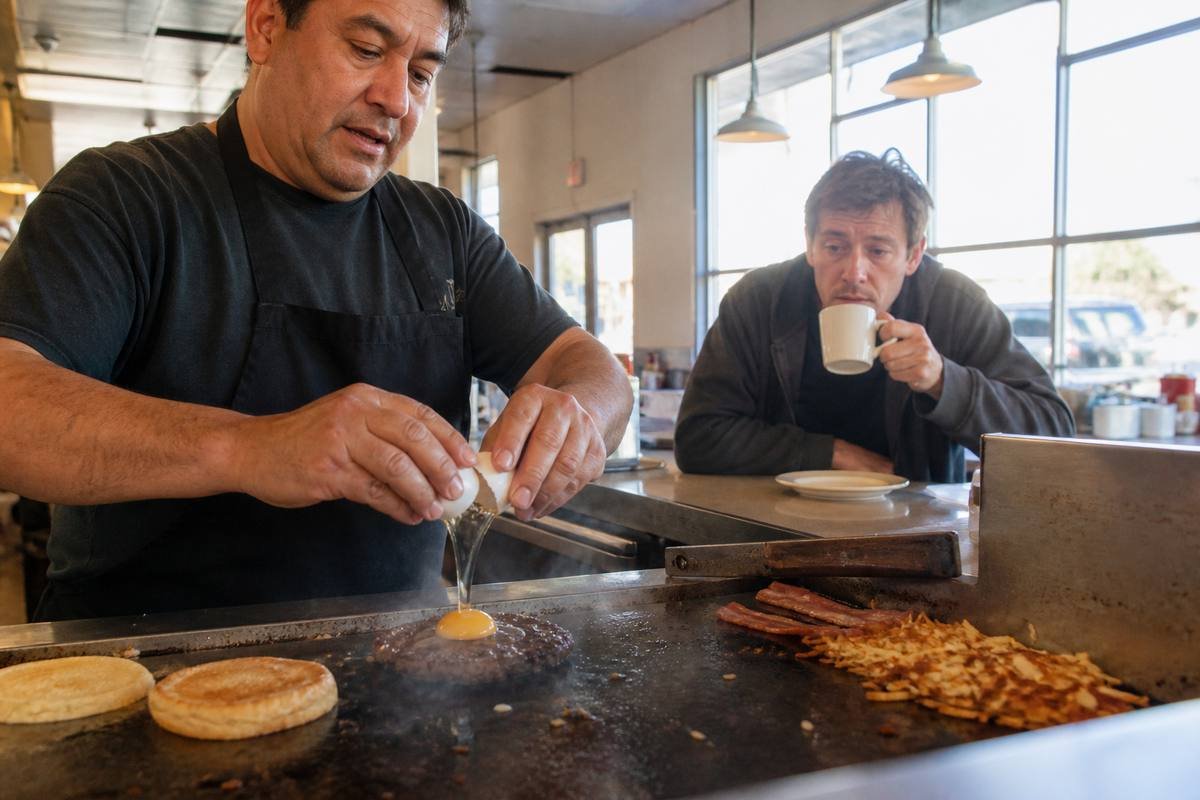
A breakfast burger looks like a dare until you eat a good one. Egg yolk on beef sounds like a hangover invention, and sometimes it is. But the better versions come from a simpler fact: morning hunger is specific. People want protein, salt, something warm they can hold, and a little fat to make coffee behave. A well-built breakfast burger is not a lunch burger with an egg dropped on top. It is a morning plate that learned how to travel in a bun.
American mornings already had the pieces. Eggs, cheese, sausage, bacon, potatoes, toasted bread, hot sauce, and the habit of eating quickly before work. The burger just gave those pieces a handle. Once you see it that way, the breakfast burger stops being a novelty and starts looking like an obvious piece of diner logic. This is the sandwich for people who do not have forty minutes and a fork, and it is worth cooking with the same care you would give a Saturday omelet.
If you have ever sat at a counter at 8 a.m. and watched a cook crack eggs with one hand while a row of patties hissed on the flat top, you already know the appeal. The room smells like butter and coffee. Somebody is reading a paper they do not need. The breakfast burger arrives looking slightly chaotic, which is honest. Morning food should not look like a photoshoot. It should look like it can get you through a shift.
What Makes a Breakfast Burger Different
Lunch burgers are built around the patty. Breakfast burgers are built around the egg. That sounds like a small shift. It changes everything. The egg is wet. It is fragile. It cools faster than beef. If you treat it like a garnish, you get a leaky sandwich and a disappointed person in a parked car. If you treat the egg as a structural ingredient, you start making better decisions about bun, cheese, and meat.
The bun has to be sturdier than a standard squishy lunch roll. A potato roll can work if it is toasted hard on the cut sides. An English muffin makes sense more often than burger people admit, because it was designed for egg and cheese in the first place. A kaiser roll can handle sausage and potato. Soft white buns fail unless they are toasted long enough to form a barrier. The breakfast burger lives or dies on that toast. You are asking bread to contain yolk, cheese, and usually some kind of pork. That is a lot to ask of an untoasted bun.
Cheese is not optional. American cheese still wins in the morning because it melts into a seal. Cheddar can work if it is young and sliced thin. Swiss is surprisingly good with ham and egg, which is just a breakfast sandwich admitting it is also a burger. The cheese should sit between the egg and the bun, or between the egg and the meat, so it acts like glue. People who put cheese on the very top are decorating. People who tuck it in are building.
Meat in a breakfast burger can be beef, sausage, bacon, or a combination that would look greedy at lunch and looks correct at breakfast. A thin smashed beef patty is often better than a thick pub burger here, because morning mouths do not want a slow, bouncy chew. Sausage patties belong. Bacon belongs if it is crisp enough to add snap instead of rubber. Canadian bacon or ham belongs if you want less grease and more diner history. The point is not maximal meat. The point is a savory center that can stand next to egg without turning the whole thing into a grease sponge.
The Egg, Which Is the Whole Craft
There are three eggs that work on a burger, and a dozen that do not. Over-medium or over-hard with a still-soft center is the diner standard: the yolk is jammy enough to sauce the sandwich and set enough not to flood the bun in five seconds. A folded omelet egg, the kind breakfast carts make, is underrated. It sits flat, covers the patty, and does not run down your wrist on the drive to work. A fried egg with crispy lace around the white is the most delicious and the most dangerous, because those lacy edges shatter and the yolk has nowhere to hide.
Scrambled egg on a burger can be excellent if it is cooked soft and piled with intention. It can also be cafeteria sad. The difference is moisture. Dry scrambled eggs turn to gravel in a bun. Soft scrambled eggs, slightly underdone on the griddle, finish inside the sandwich and stay tender. If you are cooking at home, pull the eggs earlier than you think. They keep cooking while you assemble.
Salt the egg as its own food. Pepper it too. A breakfast burger with a bland egg tastes like somebody forgot the point. A little hot sauce on the egg, not on the whole burger, is a cleaner heat than dumping a bottle over the bun. The egg is where morning flavor lives. Treat it that way.
Potatoes, Pork, and the Rest of the Morning
Hash browns inside a burger sound messy because they are. They are also one of the best ideas in American breakfast. A thin, crisp potato cake gives you crunch that bacon cannot always provide and bulk that keeps the sandwich from feeling like a snack. The trick is to cook the potato separately until it is actually crisp, then add it at the end. Soggy shredded potato in a bun is a wet sponge with opinions. Crisp potato is a reason to get out of bed.
Bacon should be cooked past the floppy stage. Morning bacon on a burger needs structure. If you want a softer pork flavor, use sausage. If you want smoke and snap, use bacon. Using both is allowed on weekends and at places that already know their audience. Just do not hide a good egg under so much pork that you cannot taste breakfast anymore.
Vegetables are a negotiation. Tomato at 8 a.m. is polarizing. A thick cold slice can make the sandwich taste like lunch too early. A thin slice on a toasted bun can be fine in summer. Pickles are underrated at breakfast; a few dill chips cut the richness the way they do at night. Avocado makes sense if it is ripe and salted, not because it is fashionable but because it calms heat and egg. Lettuce is usually a mistake in the morning unless it is a crisp shredded iceberg that adds cold crunch and nothing else.
Sauce should stay in the breakfast family. Mayo, a little mustard, hot sauce, pepper jelly if you are in the South, salsa if the kitchen already makes it, maple if you are careful. Maple and sausage can be beautiful. Maple and a smash burger can taste like a mistake you will remember. Ketchup is more acceptable at breakfast than burger snobs admit, especially with potato and egg. This is not a competition sandwich. It is breakfast.
How to Cook One at Home Without Making a Disaster
Use one pan if you can, or a griddle if you have one. Toast the bun first in fat left from bacon or a thin smear of butter, then set it aside. Cook the potato or bacon next so you have crisp things ready. Smash the beef or sausage thin. Salt it. Flip once. Add cheese immediately after the flip so it melts while the second side cooks. Fry the egg in the leftover fat. Assemble while everything is still loud and hot: bottom bun, sauce, potato if you are using it, meat and cheese, egg, bacon, top bun. Press gently. Wait ten seconds. That pause lets the cheese grab the egg. Then eat, or wrap it in paper if you are walking out the door.
Do not overbuild. A breakfast burger with five meats, two cheeses, jalapeños, onion rings, and a pancake bun is a carnival, not a morning. Pick a lane. Egg and cheese with sausage. Egg and cheese with a thin beef patty and bacon. Egg, potato, and American cheese on an English muffin. Master one of those and you will understand why people chase this sandwich.
Coffee pairing is simple. Black coffee with a fatty breakfast burger is a classic for a reason. A slightly sweet iced coffee works if the sandwich has hot sauce. Orange juice is charming and also a lot of acid next to egg and onion; sip, do not chug. If you want a shake at breakfast, that is your business, but it turns the meal into a different event.
Where the Breakfast Burger Fits in Real Life
This sandwich became common because American mornings got faster, not because chefs got bored. Parents packing kids into a car, nurses ending a night shift, road crews on a short break, travelers who cannot face another sad hotel omelet: they all need food that is hot, portable, and serious. The breakfast burger is closer to a breakfast sandwich than to a gastropub project, and that is a compliment. It belongs at diners, hotel coffee shops, airport counters, and home kitchens on Saturdays when nobody wants to set a table.
It also has a social life. Sharing fries at lunch is easy. Sharing a breakfast burger is more intimate than it looks, because the person across from you is still waking up. You see people unguarded at 8 a.m. They talk less. They eat with more focus. A good breakfast burger fits that mood. It does not demand a performance. It just asks you to sit still for eight minutes and let the day start.
If you are ordering one out, look for a kitchen that already does breakfast well. A place that can poach an egg, crisp a hash brown, and toast an English muffin can usually put a burger together in the morning. A burger-only shop adding an egg after 10:30 can still get it right, but watch the yolk. If the egg is an afterthought, you will taste it. Ask for the egg over-medium, cheese on the patty, and the bun toasted. That sentence will save you more often than any secret menu.
The breakfast burger is not trying to replace the cheeseburger, and it does not need to. It is the morning version of a national habit: take what you love, put it in bread, and make it possible to eat while the rest of life is already moving. When it is built with a real egg, a toasted bun, and a cook who is paying attention, it is one of the most comforting sandwiches you can have before noon. Eat it hot. Wipe your hands. Then get on with the day, which is the whole point of breakfast in the first place.
Leave a Reply